
Coffee Tasting Kit to Give at Christmas (Colombia 2026)
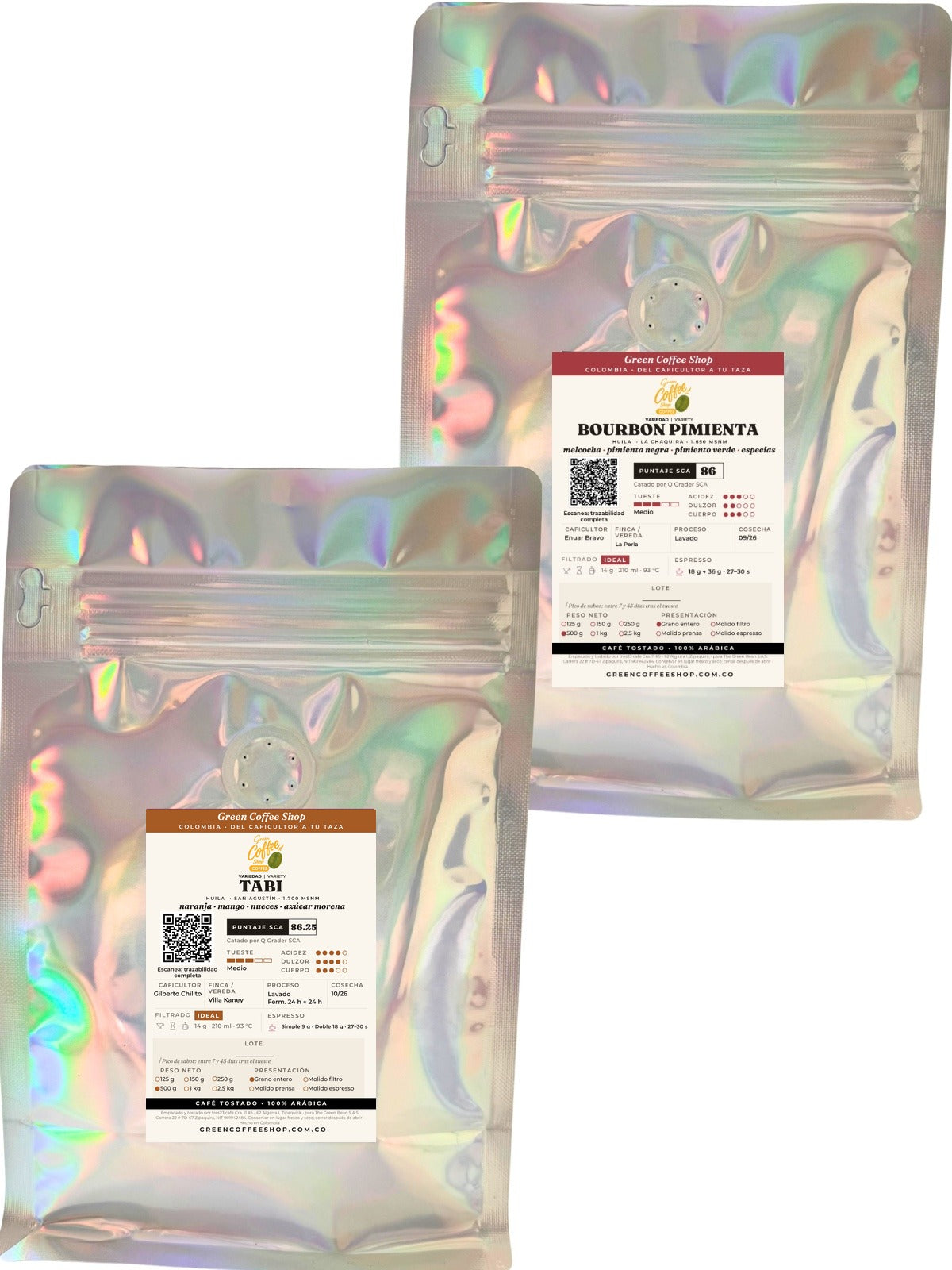
A coffee tasting kit for Christmas is a set of 2 or 3 bags of specialty coffee from different origins or processes, so the person who receives it can taste them side by side. In November 2026 the kits at The Green Coffee Shop Colombia cost between COP $57,900 and $114,900, with free shipping across Colombia. Each 150 g bag comes with grower, farm, altitude and SCA score, and we recommend ordering before 15 December for delivery in time.
Pick a tasting kit to give
Eight kits in stock: 2-bag kits from COP $57,900 to $90,900 and a 3-bag tripack at $114,900. Limited units, and stock changes daily.
See the tasting kits → Tabi and Bourbon Pimienta kit
What is a coffee tasting kit and what comes in it?
A coffee tasting kit (or cupping kit) is a set of small bags of different coffees, meant to be compared in the same week with the same brewing method. In our shop each kit holds 2 bags of 150 g (the tripack, 3), whole bean, roasted in Zipaquirá, with the details of each coffee: grower, farm, altitude in metres above sea level, variety, process and SCA score.
Comparing is what makes a kit useful. The same brew method with two different coffees shows differences a single bag cannot: one sweeter, one more citrusy, one cleaner, one more spiced. That is why a kit works both for someone starting out and for someone who already buys specialty coffee.
Three terms you will see on the sheets, in plain words:
- Washed: the bean is washed before drying; the cup tends to be clean and bright.
- Natural: the bean dries inside the cherry; the cup tends to be fruitier and winey.
- SCA: a cupping score out of 100. Our kits range from 85 to 87, cupped by a Q Grader. It tells you how clean and complex the coffee is, not whether a particular person will like it.
How much does a coffee gift kit cost in Colombia?
At The Green Coffee Shop Colombia, a 2-bag kit of 150 g costs between COP $57,900 and $90,900, and the 3-bag tripack costs $114,900 (prices of 23 November 2026). Shipping is free across Colombia. These are the kits in stock today:
| Kit | What is inside | Best for | Approx. cups | Price (COP) |
|---|---|---|---|---|
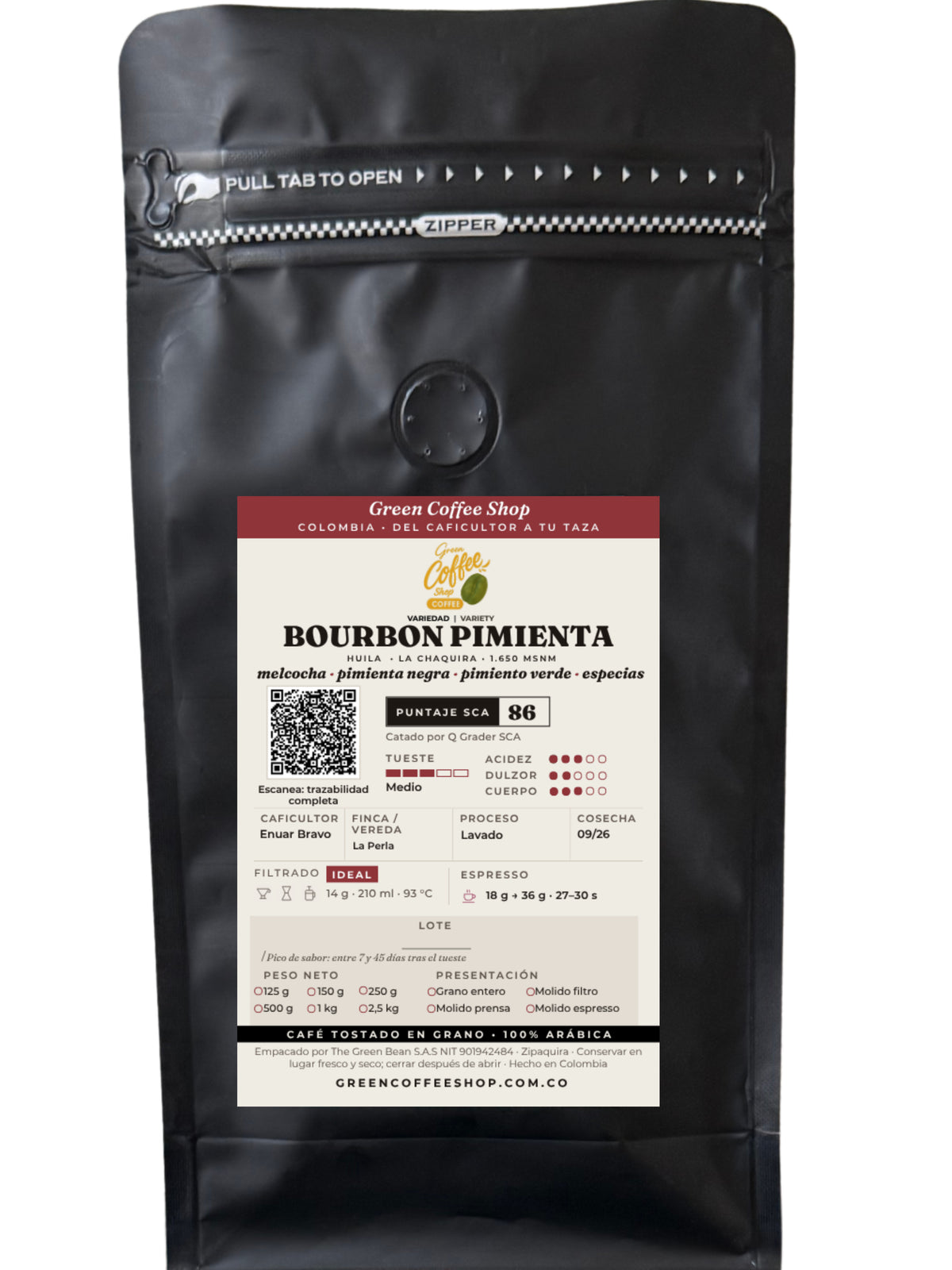
| Tabi and Bourbon Pimienta · Sweet and spiced | Two washed Huila coffees: Tabi (SCA 86.25) and Bourbon Pimienta (SCA 86) | Someone who likes sweet with a touch of spice | 20 (2×150 g) | $72,900 |
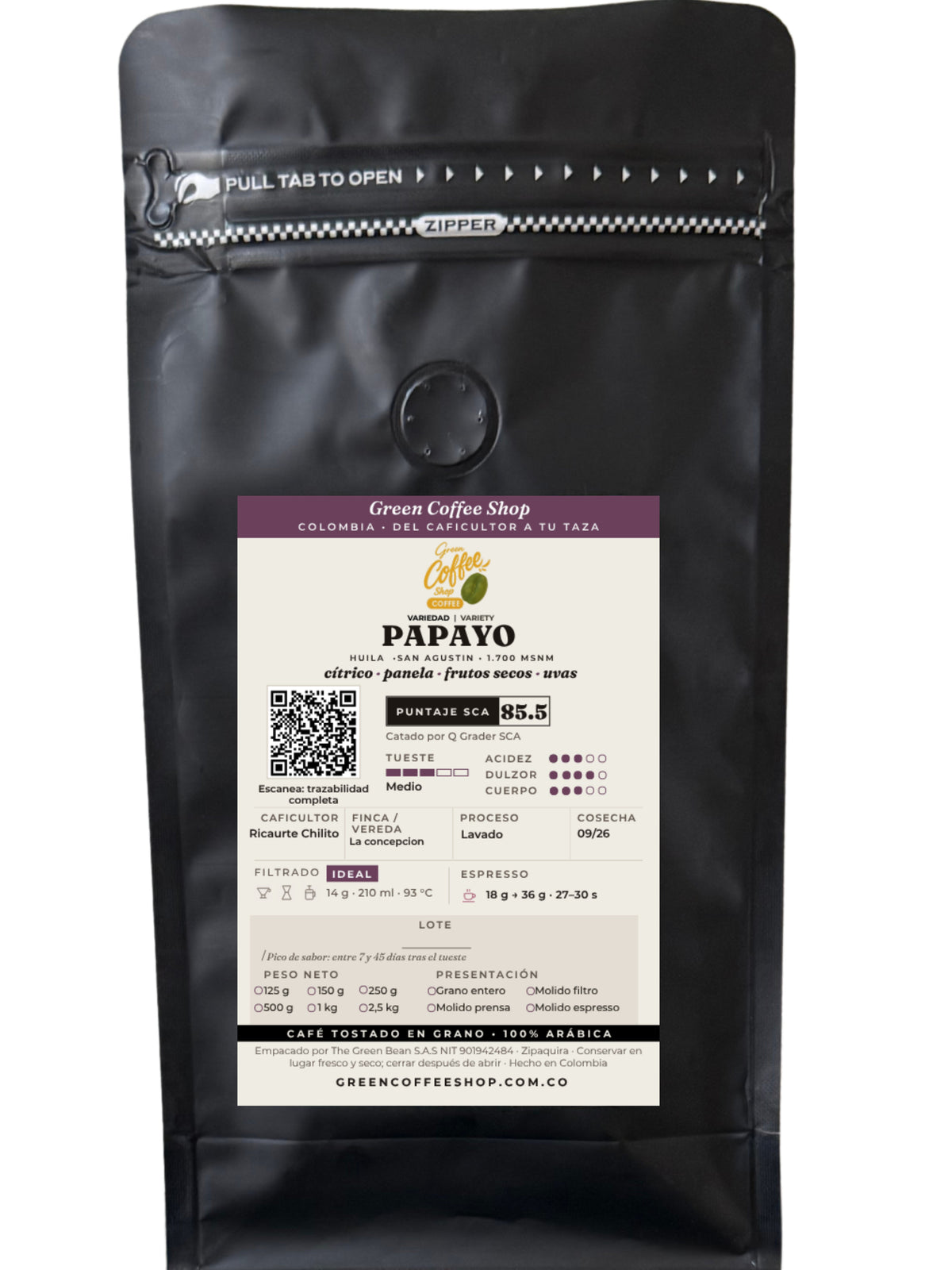
| Washed Huila Tripack: Geisha, Papayo and Tabi | Three washed Huila coffees: Geisha (SCA 86), Papayo (SCA 85.5) and Tabi (SCA 86.25) | Someone who wants to compare three profiles and has room in the budget | 30 (3×150 g) | $114,900 |
| Geisha and Papayo · San Agustín novelties | Geisha (SCA 86) and Papayo (SCA 85.5), both from San Agustín | Someone who knows specialty coffee and wants uncommon varieties | 20 | $73,900 |
| Geisha and Blend · One farm, two cups | Geisha (SCA 86) and Blend (SCA 85), both from Edgar Dorado, El Caracol | Someone who wants to see how the cup changes within one farm | 20 | $64,900 |
| Colombia and Papayo · Classic | Colombia from Nariño (SCA 85) and Papayo from San Agustín (SCA 85.5) | Someone starting in specialty coffee | 20 | $64,900 |
| Caturra Amarillo and SL28 · First tasting | Caturra Amarillo (SCA 85) and SL28 (SCA 85), from Huila | Someone who wants a first variety tasting, sweet against fruity | 20 | $72,900 |
| Espresso: Colombia and Caturra Amarillo | Colombia from Nariño (SCA 85) and Caturra Amarillo from Huila (SCA 85) | Someone who makes espresso or milk drinks | 20 | $57,900 |
| Bourbon Rosado Coco and Sidra · Two origins | Rosado Coco natural (SCA 87, Sierra Nevada) and washed Sidra (SCA 86, Pitalito) | Someone who wants a surprise outside the usual | 20 | $90,900 |
 Tabi and Bourbon Pimienta · HuilaGilberto Chilito, Villa Kaney, 1,700 masl · orange · mango · nuts · brown sugarBourbon Pimienta, La Chaquira, 1,650 masl · caramel candy · black pepper · spicesCOP $72,900 · 2×150 g whole bean
 Geisha, Papayo and Tabi Tripack · HuilaGeisha, Edgar Dorado, 1,950 masl · lemon verbena · roses · figs · sugar canePapayo, Ricaurte Chilito, 1,700 masl · citrus · panela · dried fruit · grapesCOP $114,900 · 3×150 g whole bean
 Geisha and Papayo · San AgustínEdgar Dorado (Geisha) · Ricaurte Chilito (Papayo) · SCA 86 and 85.5COP $73,900 · 2×150 g whole bean
 Geisha and Blend · One farm, two cupsEdgar Dorado, El Caracol · Blend: caramel · sugar cane · nuts · SCA 85COP $64,900 · 2×150 g whole bean
Which coffee kit should you give?
Choose by how the person brews and which flavours they enjoy, not by the highest price. This quick guide summarises the kits in the table:
| If the person… | Give this kit | Why |
|---|---|---|
| Is starting in specialty coffee | Colombia and Papayo · Classic (COP $64,900) | Two sweet washed coffees that are easy to read: cacao and brown sugar against citrus and panela |
| Drinks espresso or milk coffees | Espresso: Colombia and Caturra Amarillo (COP $57,900) | Two sweet coffees (cacao, brown sugar, honey, caramel) chosen for espresso |
| Likes sweet with a little spice | Tabi and Bourbon Pimienta (COP $72,900) | Orange and brown sugar in the Tabi; caramel candy and black pepper in the Bourbon Pimienta |
| Knows coffee and wants rare varieties | Geisha and Papayo (COP $73,900) or the Tripack (COP $114,900) | Floral Geisha and citrusy Papayo; the tripack adds the Tabi |
| Enjoys comparing within one farm | Geisha and Blend · One farm, two cups (COP $64,900) | Both come from Edgar Dorado, in El Caracol |
| Wants something unexpected | Bourbon Rosado Coco and Sidra (COP $90,900) | Rosado Coco is a natural with a selected yeast: it tastes of coconut without any coconut added |
 Colombia and Papayo · ClassicAdolfo Ruiz, Sandoná, Nariño, 1,820 masl · cacao · brown sugar · berriesCOP $64,900 · 2×150 g whole bean
 Caturra Amarillo and SL28 · First tastingCaturra Amarillo: honey · lemon peel · toasted almond · caramelSL28, Juan Camilo, Laboyani farm, Pitalito: pink grapefruit · red fruitCOP $72,900 · 2×150 g whole bean
 Espresso: Colombia and Caturra AmarilloColombia, Sandoná, Nariño · Caturra Amarillo, San Agustín, Huila · SCA 85COP $57,900 · 2×150 g whole bean
 Bourbon Rosado Coco and Sidra · Two OriginsRosado Coco, Corintios farm, Sierra Nevada, SCA 87 · washed Sidra, Pitalito, SCA 86COP $90,900 · 2×150 g whole bean
What we know and what we do not about a coffee kit
- VERIFIED FACT: the details of each coffee (grower, farm, altitude, process, SCA score and notes) are on each kit page and on the bag.
- VERIFIED FACT: Rosado Coco is a natural coffee made with a selected yeast; no coconut is added. The coconut note comes from the process.
- What the score does not say: whether the recipient will like the coffee. A fruity SCA 87 may not win over someone who prefers a cacao-style cup. That is why a two-profile kit is safer than a single bag.
- What we do not promise: that a given kit stays available. Units are limited and change daily.
How do you taste coffee at home with a kit?
You can taste at home with two cups per coffee, hot water and a spoon: smell the dry grounds, steep for 4 minutes and compare. It is a home version of the SCA cupping protocol: same weight, same water and same time, so only the coffee changes.
Home tasting of two coffees (the card to save)
- Coffee: 10 g per cup, ground coarse just before brewing. Use 2 cups per coffee.
- Water: 180 ml at about 93 °C per cup, poured in one go over all the grounds.
- Time: 4 minutes of rest. Break the crust with the spoon while smelling, then skim the foam.
- Taste: once it cools, slurp from the spoon. Write down 3 notes and which cup you prefer.
- How much: a 150 g bag is enough for several tastings and for brewing the rest your usual way.
- Weigh and grind. 10 g per cup, whole beans ground just before. If the recipient has no grinder, a manual grinder is a good add-on: our kits come as whole beans.
- Smell the dry grounds. Before adding water, smell each coffee and note your first idea: floral, sweet, spiced, fruity.
- Pour the water and wait 4 minutes. Same volume, same temperature and same time for both coffees.
- Break the crust and skim. This is the most aromatic moment; lean in and smell.
- Taste once it cools a little. Slurp hard so the coffee reaches the whole mouth. Taste again at 5 and 10 minutes: flavours change as it cools.
- Compare with the notes on the bag. Do not expect to find them all: three notes of your own is already a good tasting. Pick your favourite and use it for this week's filter.
When should you order a coffee kit so it arrives before Christmas?
We recommend ordering before 15 December. Roasted coffee leaves Zipaquirá (Cundinamarca) and arrives in 2 to 4 business days anywhere in Colombia, with free shipping. 8 and 25 December are public holidays and couriers get congested in December, so leave some margin. Enter the recipient's address at checkout.
Pay with Bold (card, PSE or Nequi); Mercado Pago is also available. In Bogotá and Cundinamarca there is cash on delivery, with an extra COP $5,000 charge.
If you live abroad and want to send a kit to someone in Colombia, order with the recipient's address in Colombia. For delivery outside Colombia, message us on WhatsApp first: shipping rules depend on the destination country.
What about coffee gifts for a company?
For Christmas gifts to teams or clients (several kits at once, or several delivery addresses in Colombia), message us on WhatsApp with the quantity, the cities and the deadline, and we will tell you which kits are in stock and how they ship. Units of each kit are limited, so it pays to ask early.
Corporate coffee gifts
Tell us how many kits you need, to how many cities and by what date.
Get a quote on WhatsApp →Order your tasting kit before 15 December
- 8 kits in stock from COP $57,900, whole bean, roasted in Zipaquirá.
- Free shipping within Colombia, 2 to 4 business days.
- Pay with Bold (card, PSE or Nequi); Mercado Pago also available.
Frequently asked questions
What is a coffee tasting kit?
It is a set of small bags of different coffees for comparing them. At The Green Coffee Shop Colombia, each kit holds 2 bags of 150 g whole bean (the tripack, 3), with the grower, farm, altitude, process and SCA score of each coffee. It helps you find which profile you prefer before buying a big bag.
How much does a coffee gift kit cost?
Our 2-bag kits of 150 g cost between COP $57,900 and $90,900, and the 3-bag tripack costs $114,900, according to our shop on 23 November 2026. Shipping is free within Colombia. Units of each kit are limited.
Which coffee kit should I give if I do not know what they like?
A kit of two sweet washed coffees is the safest bet. The Colombia and Papayo Kit (COP $64,900) pairs cacao and brown sugar with citrus and panela. For something more spiced, the Tabi and Bourbon Pimienta Kit ($72,900). For espresso or milk drinks, the Espresso Kit ($57,900).
How many cups does a kit of two 150 g bags make?
About 20 filter cups at 14 g per cup, the recipe on our labels; at 15 g you get about 10 per bag. For tasting, 10 g per cup stretches further. The three-bag tripack makes about 30 filter cups.
How do I taste coffee at home with a kit?
Grind 10 g of each coffee into two cups, pour 180 ml of water at about 93 °C and wait 4 minutes. Break the crust, skim the foam and slurp once it cools. Write down three notes per coffee and compare which you prefer.
When should I order so it arrives before Christmas?
We recommend ordering before 15 December. Coffee leaves Zipaquirá and arrives in 2 to 4 business days anywhere in Colombia, with free shipping. 8 and 25 December are holidays and couriers get busy in December, so leave some margin.
Do the kits come whole bean or ground?
Our kits are sold as whole beans. Whole beans keep their aroma better than ground coffee, but the recipient needs a grinder; if they have none, a manual grinder is a good add-on to the gift. Single bags of roasted coffee can be ordered ground.
Can I buy coffee kits as company gifts?
Yes. For several kits or several addresses in Colombia, message us on WhatsApp with the quantity, cities and deadline, and we will confirm which kits are in stock and how they ship. Units of each kit are limited, so ask early.
Review
Reviewed by a licensed Q Grader (Licence Q-117598) · The Green Coffee Shop Colombia, Zipaquirá, Cundinamarca.


Comments