
Green Geisha coffee: price per kilo, lot sheet and samples for roasters
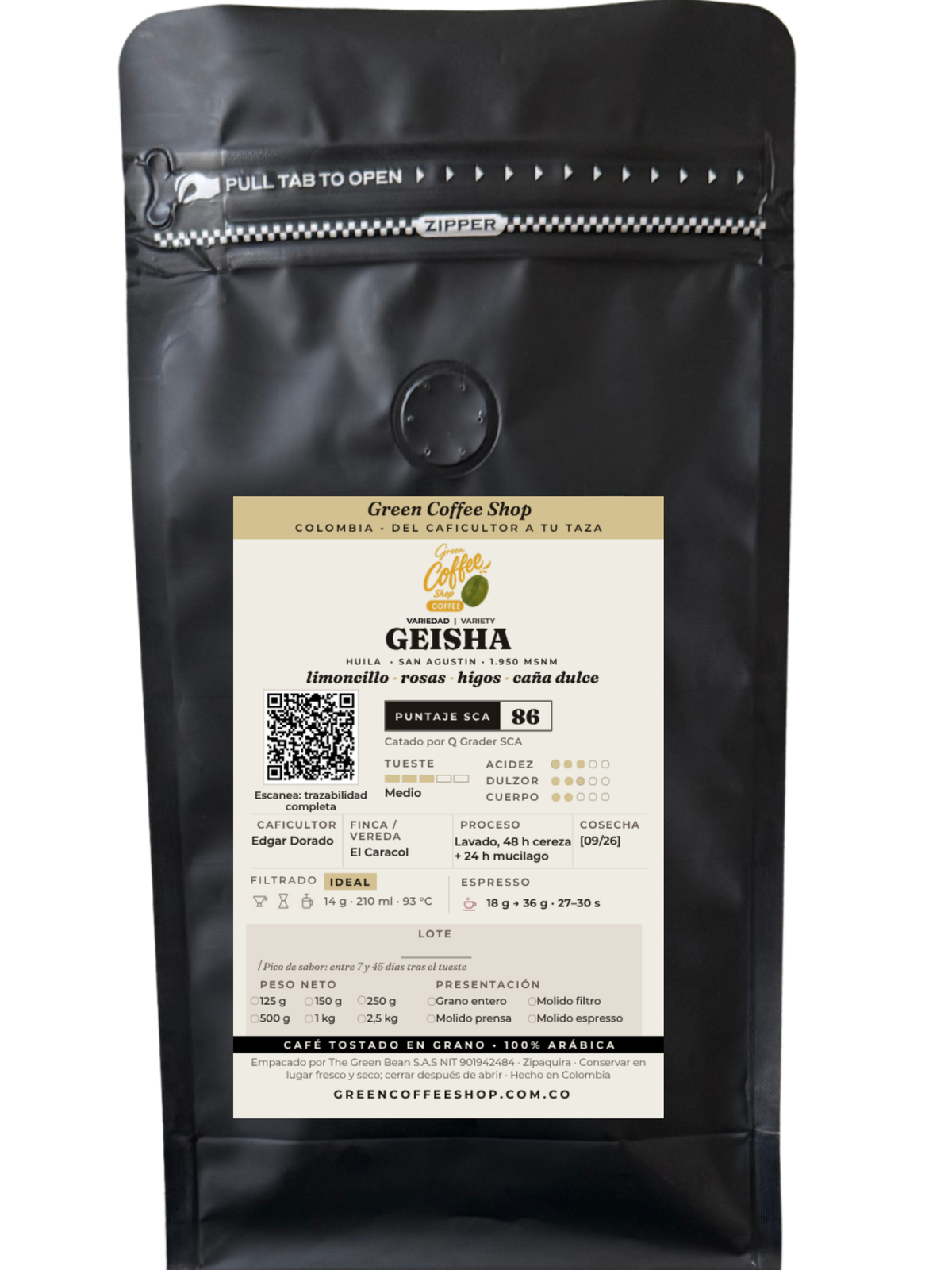
Green Geisha coffee in Colombia costs today, 13 November 2026, between $95.000 and $115.000 per kilo for Huila and Cauca lots ready to roast, depending on the lot; at a volume of 5 kg it drops to $85.500/kg and $103.500/kg. At The Green Coffee Shop Colombia the three green Geisha lots are a washed from San Agustín (Huila), a natural from Huila and a natural from Cauca, with a cupping sheet per lot, and a calibration sample of 200 g to 1 kg whose value is credited to your first order.
Get a quote for this green coffee on WhatsApp
Tell us how many kilos you roast a month, which process you're after (washed or natural) and the screen size. We'll reply with the lot in stock, the volume price and the cupping sheet.
Get a green Geisha quote on WhatsApp → See the green Geisha NaturalHow much does green Geisha coffee cost in Colombia?
It depends on process, screen size and volume. These are the prices per kilo for our three green Geisha lots (two from Huila and one from Cauca), milled and packed, on 13 November 2026. UGQ is the mix of sizes as it comes out of the mill; Excelso and Supremo are screen-size selections.
| Green Geisha lot | 1 kg | 5 kg (per kg) | 35 kg (per kg, list price) |
|---|---|---|---|
| Geisha Washed · San Agustín, Huila | $95.000 | $85.500 | $76.000 |
| Geisha Natural · Cauca | $95.000 | $85.500 | $76.000 |
| Geisha Natural · Huila (UGQ) | $115.000 | $103.500 | $92.000 |
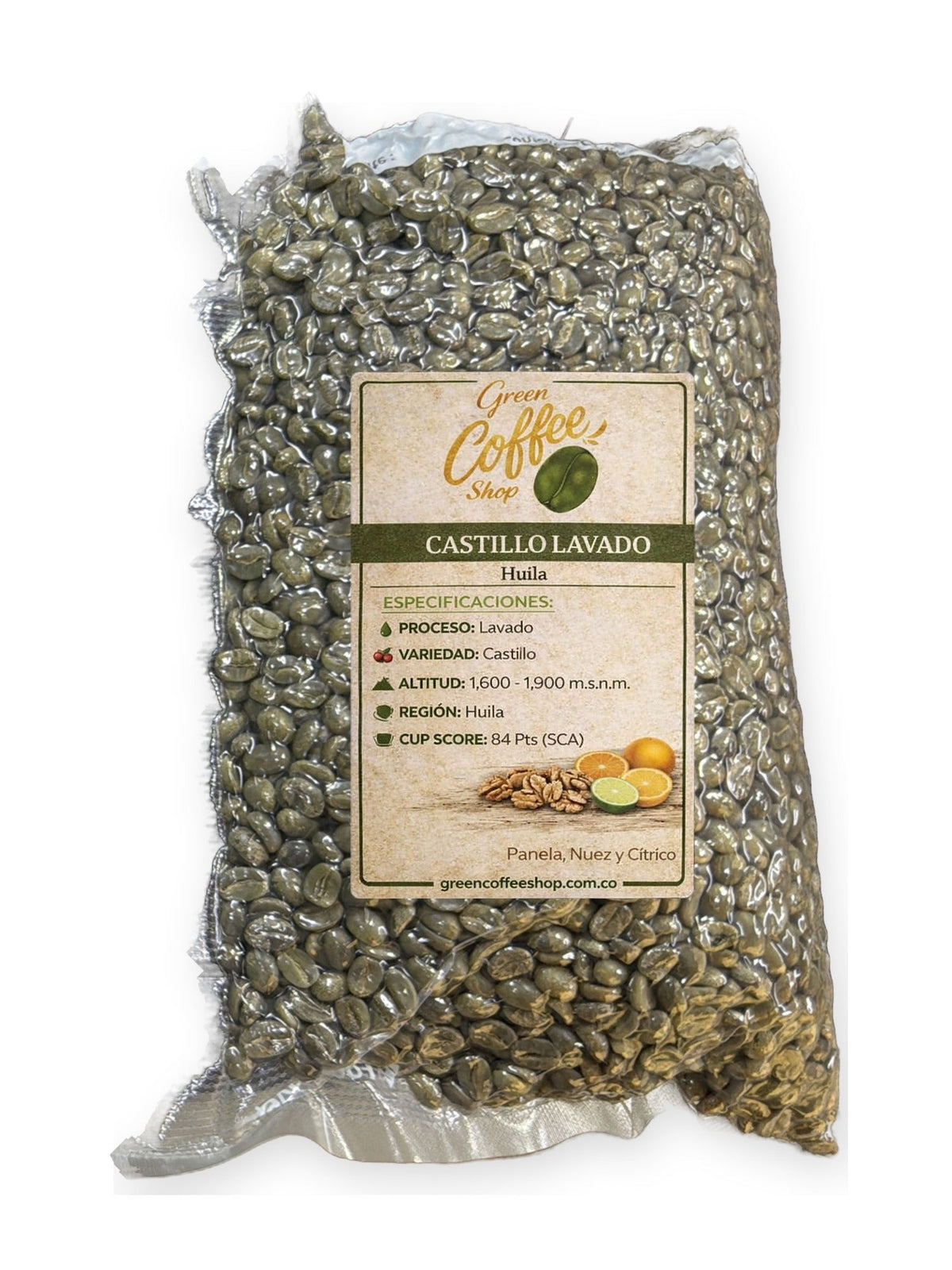
| Castillo Washed · Santander (comparison, premium commercial, UGQ) | $61.000 | $54.900 | $48.900 |
 Geisha Natural · Huilajasmine · mango · passion fruit · honeyFrom $115.000/kg (1 kg) · $103.500/kg in 5 kg
 Geisha Washed · San Agustín, Huilalemongrass · roses · figs · sugarcaneFrom $95.000/kg (1 kg) · $85.500/kg in 5 kg
Why is Geisha coffee so expensive? What auctions pay
Because demand from specialty buyers outstrips the supply of a variety that yields little per tree, and because auctions have set a very high price reference. Geisha isn't priced by the New York exchange: it's priced by score, process and traceability. This is how the public references for 2025 and 2026 look next to our store price:
| Reference | Price | Per-kilo equivalent (COP) | What it is |
|---|---|---|---|
| FNC domestic reference price, 29 Oct 2026 | $2.025.000 per 125 kg load of dry parchment | ≈ $21.800 per kg of equivalent green bean (factor 94) | Standard coffee, before milling and sorting |
| Green Geisha Washed, The Green Coffee Shop Colombia, 13 Nov 2026 | $95.000 per kg (1 kg) | $95.000, about 4.4 times the FNC reference | Milled lot from Huila, ready to roast |
| Green Geisha Natural, The Green Coffee Shop Colombia, 13 Nov 2026 | $115.000 per kg (1 kg UGQ) | $115.000, about 5.3 times the FNC reference | Milled lot from Huila, ready to roast |
| FICCA 2026 auction, Neiva (8 Oct 2026) | US$90 per pound | ≈ US$198 per kg, about $629.000 at the 29 Oct 2026 rate | Washed Geisha from Víctor Félix Ramírez Cruz, finca La Fortuna, Pitalito, Huila |
| Best of Panama 2025 (7 Aug 2025) | US$30.204 per kg | ≈ $95.7 million at the 29 Oct 2026 rate | Washed Geisha from Hacienda La Esmeralda, 20 kg lot: auction record |
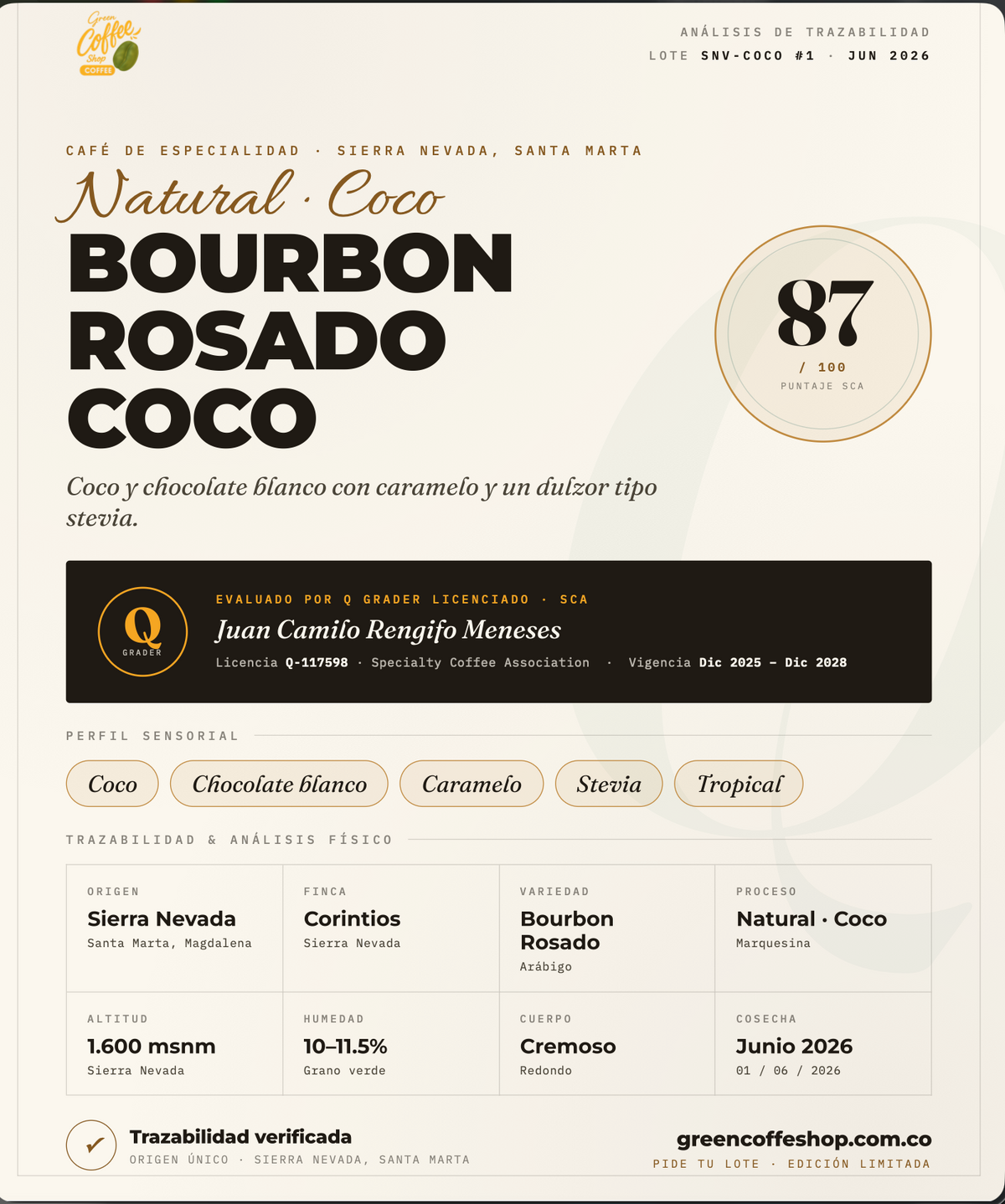
 Geisha Natural · Cauca · Finca Río Cofrehibiscus flower · jasmine · blueberry jam · panelaFrom $95.000/kg (1 kg) · $85.500/kg in 5 kg
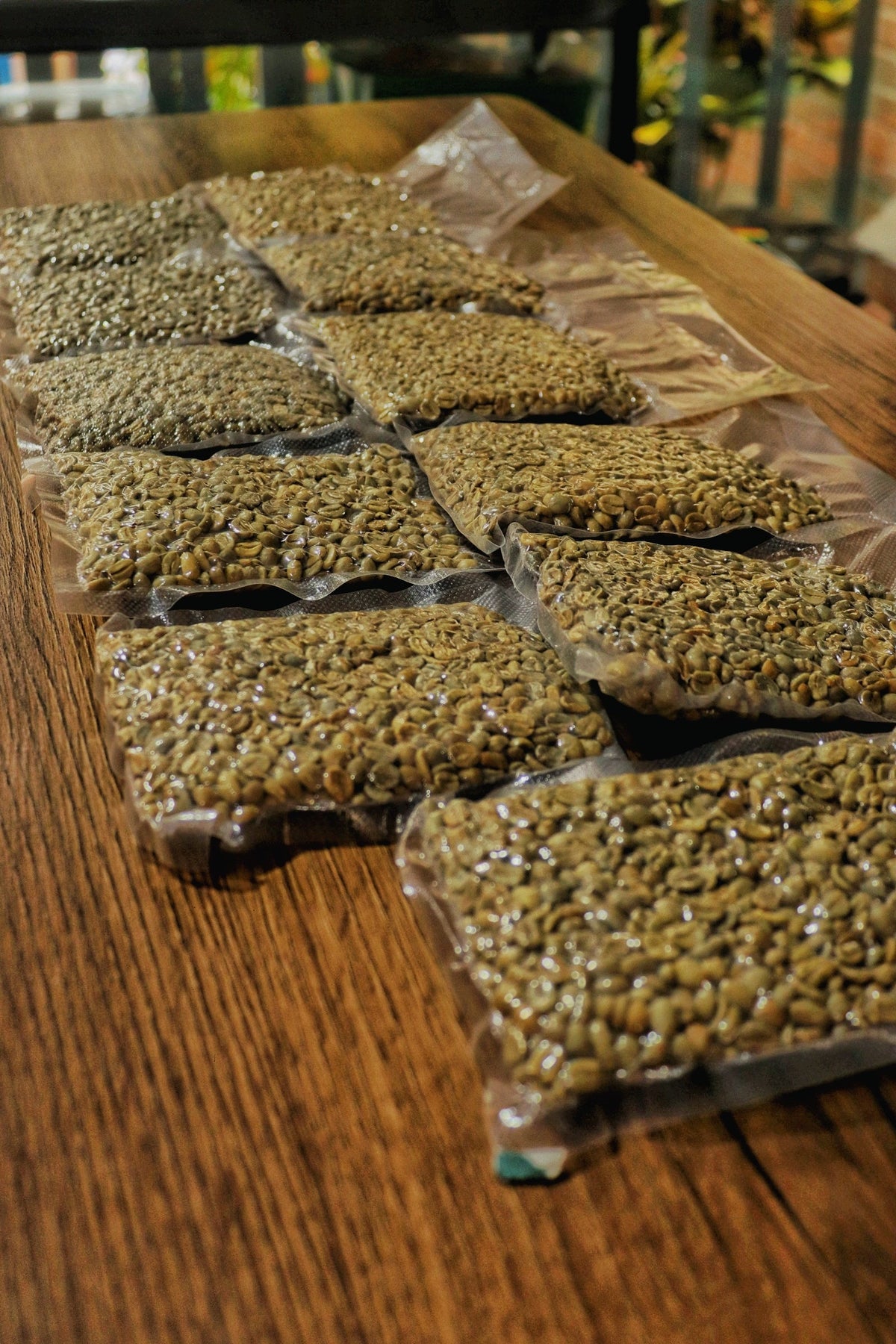
Samples for roastersGeisha calibration kit of 200 g to 1 kg on WhatsApp: its value is credited to your first green coffee order.Sample kits of other origins in the store from $48.000.
What is Geisha coffee and where does it come from?
Geisha (also written Gesha) is a variety of Coffea arabica from the Gesha area in south-western Ethiopia, which reached Central America via the CATIE research centre in Costa Rica and became famous in Boquete, Panama. Sources agree on the Ethiopian origin and the 2004 breakthrough; they differ on the dates of the journey, so we keep them separate:
What is known and what is disputed
- VERIFIED FACT: at the 2004 Best of Panama, Hacienda La Esmeralda separated a 100 % Geisha lot from the upper part of its Jaramillo farm for the first time, won the competition and that year set the highest price paid until then for a coffee at auction (haciendaesmeralda.com, read on 30 Oct 2026).
- VERIFIED FACT: at the 2025 Best of Panama the same hacienda's washed Geisha lot sold for US$30.204 per kilo, and the natural for US$23.608 per kilo (La Estrella de Panamá, 7 Aug 2025).
- VERIFIED FACT: in Huila, a washed Geisha from finca La Fortuna (Pitalito) sold for US$90 per pound at the FICCA 2026 auction in Neiva (Portafolio, 8 Oct 2026).
- DISPUTED: when and how it left Ethiopia. TheCollector (Jun 2026) speaks of seeds documented in the 1930s by the British consul Richard Whalley, arrival at CATIE in the 1950s and Don Pachi Serracín taking them to Boquete in 1963. Coffee Review (Meza, 2010) only confirms that Don Pachi brought them from CATIE in the 1960s looking for leaf-rust resistance. Other sources mention a stop in Tanzania that we couldn't verify.
- What no auction price tells you: how the lot behaves in your roaster. That's why we sell calibration samples before the sack.
Two agronomic traits explain the price and appear in every source we opened: the variety yields little per tree and expresses itself best at altitude. The Geisha Natural we work with in Huila is yellow-fruited, a line that in our cuppings gives very defined floral and citrus notes.
What does Huila Geisha taste like? The cupping sheet for the natural lot
It tastes of white flowers and tropical fruit with honey sweetness, and feels light and silky, tea-like. This is what the SCA cupping sheet (combined format) for the Geisha Natural lot recorded in October 2026:
| Attribute | What the Geisha Natural sheet says (Oct 2026) |
|---|---|
| Fragrance and aroma | Jasmine, white flower, dried peach, honey, orange blossom, mango, passion fruit. "Very intense and complex aroma." |
| Flavour and aftertaste | Mango, passion fruit, peach, mandarin, honey and elegant floral notes. Long, clean, floral aftertaste, with lingering honey-like sweetness. |
| Acidity | Citric and malic: bright, juicy and elegant. |
| Sweetness | Evident, honey-like. |
| Body | Light, silky, elegant, tea-like. |
| Overall impression | "Outstanding. Complex, perfect for filter (V60, Origami, Kalita)." |
| Physical data (store sheet) | Moisture 10.8 % · factor 91 · screen 15/16 in UGQ · SCA 87.5 |
For the floral profile to reach the cup, all three lots are intended for filter methods; we don't sell them as espresso coffees. When roasted, the natural produces more fines when ground and calls for a slightly coarser grind; the washed does well with wider ratios (1:16 to 1:17) and water at 92–93 °C.
Cost of green Geisha per cup and per bag (filter, 14 g)
- Assumption: 15 % roast loss: 1 kg of green gives 850 g roasted, about 60 cups of 14 g or 3.4 bags of 250 g.
- Geisha Washed, 1 kg ($95.000): ≈ $1.600 per cup · ≈ $27.900 of green coffee per 250 g bag
- Geisha Washed, 5 kg ($85.500/kg): ≈ $1.400 per cup · ≈ $25.100 per 250 g bag
- Geisha Natural, 1 kg ($115.000): ≈ $1.900 per cup · ≈ $33.800 per 250 g bag
- Geisha Natural, 5 kg ($103.500/kg): ≈ $1.700 per cup · ≈ $30.400 per 250 g bag
How to buy green Geisha without getting it wrong?
- Decide the process before the price. Washed for a clean, floral cup; natural for ripe fruit and a juicier body. The San Agustín washed and the Cauca natural are the cheapest of the three today ($95.000/kg).
- Compare in the same unit. Pesos per kilo of milled green bean, with the screen size stated. UGQ, Excelso and Supremo from the same lot don't cost the same or roast the same.
- Ask for the cupping sheet and physical data. Notes, moisture (10–12 % is the usual range requested) and factor. If the seller doesn't know who grew it, you won't be able to repeat the lot.
- Roast a calibration sample before the sack. 200 g to 1 kg with your usual profile. The sample's value is credited to your first green coffee order.
- Work out the cost per bag, not per kilo. With the card above: a Geisha Washed at $95.000/kg puts about $27.900 of green coffee in each 250 g bag. That's the number that decides your selling price.
Looking for Geisha for your roastery? Get a quote from us
- Three Geisha lots: washed from San Agustín (Huila), natural from Huila and natural from Cauca. Excelso and Supremo of the Huila natural, on request via WhatsApp.
- Calibration kit of 200 g to 1 kg per lot: its value is credited to your first green coffee order.
- Cupping sheet and physical data for each lot.
Frequently asked questions
How much does a kilo of green Geisha coffee cost in Colombia?
At The Green Coffee Shop Colombia, on 13 November 2026, a kilo of green Geisha costs $95.000 for the San Agustín (Huila) washed, $95.000 for the Cauca natural and $115.000 for the Huila natural (UGQ grade). At 5 kg the price per kilo drops to $85.500 and $103.500. Excelso and Supremo screen sizes of the Huila natural are on request via WhatsApp: we check with the grower first.
Why is Geisha coffee so expensive?
Because the variety yields little per tree, expresses itself best at altitude and specialty buyers have sought it since it won the Best of Panama in 2004. Auctions set very high references: US$30.204 per kilo in Panama in 2025 and US$90 per pound for a Geisha from Pitalito at FICCA 2026 in Neiva.
Where is the Geisha variety from?
From south-western Ethiopia, the Gesha area. It reached Central America through the CATIE research centre in Costa Rica and was planted in Boquete, Panama, where Hacienda La Esmeralda made it famous in 2004. The exact dates of the journey from Ethiopia vary by source. In Colombia it's grown mainly in Huila.
What does Huila Geisha coffee taste like?
Our lot's Geisha Natural gives jasmine, white flower, mango, passion fruit, peach and honey, with citric and malic acidity, honey sweetness and a light, silky, tea-like body, according to its October 2026 cupping sheet. The San Agustín washed leans to lemongrass, roses, figs and sugarcane; the Cauca natural, to hibiscus flower, jasmine, blueberry jam and panela.
Geisha washed or natural: which to buy for roasting?
Washed if you want the cleanest, most floral cup ($95.000/kg). Natural if your customer prefers ripe fruit and a juicy body; grind a little coarser because it produces more fines. All three are intended for filter, not espresso.
Can I try the green Geisha before buying a sack?
Yes. Ask on WhatsApp for a calibration kit of 200 g to 1 kg of the lot you're interested in (washed or natural). It's a paid sample and its value is credited to your first green coffee order. You can also buy 1 kg of any of the three lots directly in the store.
Review
Reviewed by a Q Grader with licence Q-117598 · The Green Coffee Shop Colombia, Zipaquirá, Cundinamarca.


Comments