
Price of green coffee today in Colombia: how to read it and how much a kilo costs
The price of green coffee today in Colombia published by the Federación Nacional de Cafeteros (FNC) is the price of a 125 kg load of dry parchment coffee, not of a kilo of green coffee ready to roast: on 29 October 2026 it was $2.025.000 per load. Converted to green bean at factor 94, that's about $21.800 per kilo before milling, sorting and transport; a milled lot graded by screen size at The Green Coffee Shop Colombia costs from $46.400/kg (35 kg) or $58.000/kg (1 kg).
Get a quote for this green coffee on WhatsApp
Tell us how many kilos you roast a month, the screen size and the profile you're after. We'll reply with lots in stock, a volume price and the sheet for each lot.
Get a quote on WhatsApp → See today's green coffee pricesWhat price is published and what doesn't it include?
When you search for "a cómo está la carga de café" (what a load of coffee is going for), what you find is the FNC's domestic reference price. According to the Federation itself, it's a base market price calculated from the closing quote on the New York exchange, the dollar rate and the reference differential or premium for Colombian coffee. That number describes a specific product:
- Dry parchment coffee, that is, with the husk still on. You don't roast parchment: you roast green bean (milled green coffee).
- A 125 kg load, not a kilo.
- Yield factor 94: 94 kg of parchment are needed to get 70 kg of excelso.
- It doesn't include milling, screen sorting, transport to your roastery or packaging.
From the price per load to the price per kilo of green coffee
With the yield factor formula (125 kg ÷ factor × 70) you can read any offer. These are the numbers with the price of 29 October 2026:
| What you're looking at | Calculation | Price (COP) |
|---|---|---|
| 125 kg load of dry parchment, factor 94 (FNC) | Published | $2.025.000 / load |
| Kilo of dry parchment | 2.025.000 ÷ 125 | $16.200 / kg |
| Equivalent kilo of green bean, factor 94 | 2.025.000 ÷ 93.1 kg | ≈ $21.800 / kg |
| Equivalent kilo of green bean, factor 88 | 2.025.000 ÷ 99.4 kg | ≈ $20.400 / kg |
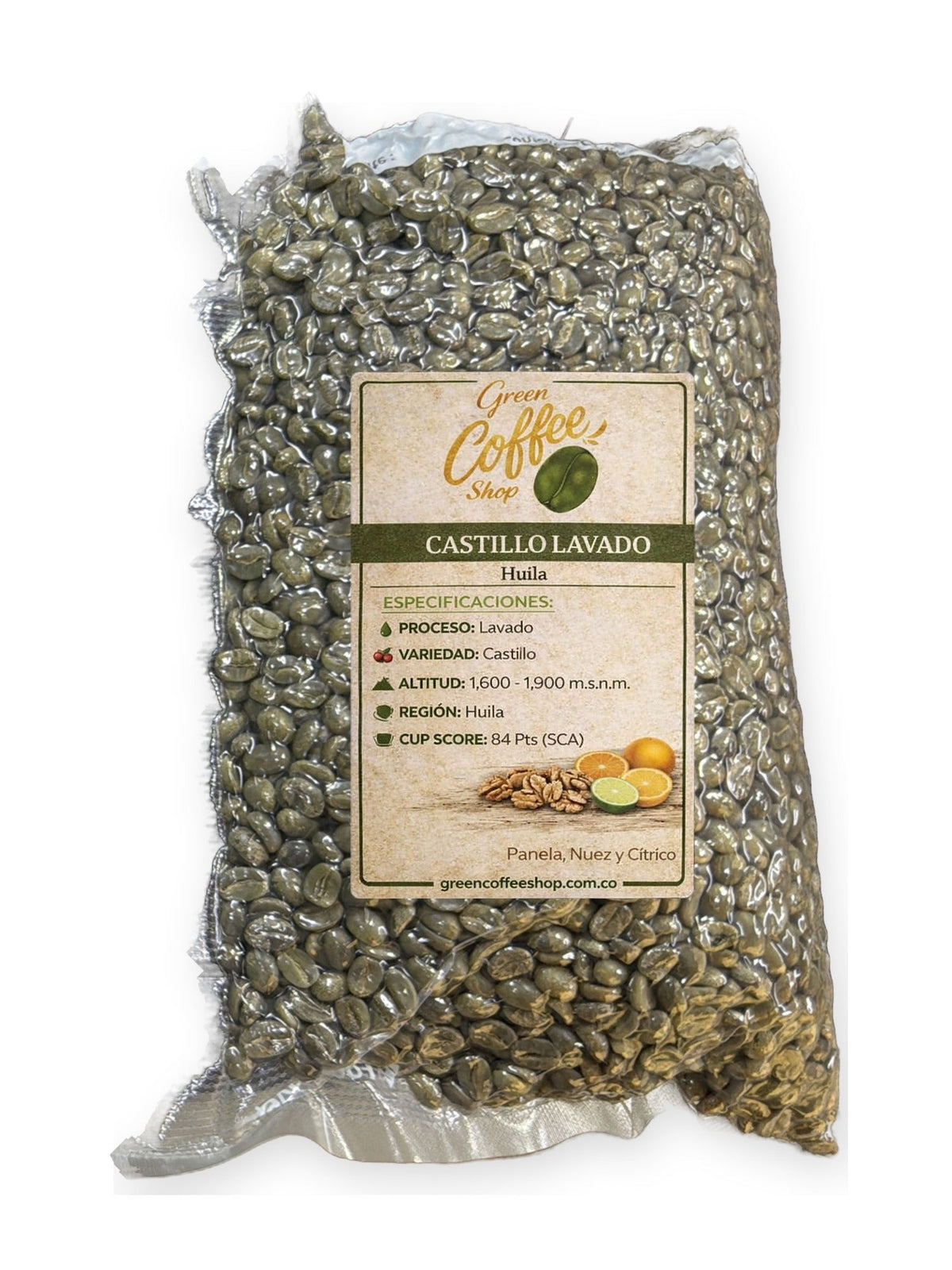
| Milled green coffee, Castillo Washed, UGQ, 35 kg sack | Store price | $48.900 / kg |
| Milled green coffee, Castillo Washed, UGQ, 1 kg | Store price | $61.000 / kg |
 Castillo Washed · Nariñodried fruit · nuts · cacao · brown sugarFrom $65.000/kg (1 kg) · $52.000/kg in 35 kg
Sample kits for roastersTry several origins before buying volume. From $48.000.Calibration kit of 200 g to 1 kg on WhatsApp: its value is credited to your first order.
How much is a load of coffee and what's it going for today?
A load of coffee (carga) is 125 kg of dry parchment coffee: it's the unit the FNC uses to publish its domestic reference price and the one cooperatives buy in. It isn't 125 kg of green coffee: at factor 94, that load yields about 93.1 kg of green bean, and at factor 88 about 99.4 kg. On 29 October 2026 the load stood at $2.025.000 (FNC), that is, $16.200 per kilo of dry parchment.
If you're looking for "what a load of coffee is going for today", check the day's figure on federaciondecafeteros.org: it changes every business day and the FNC notes that it varies with the distance of the buying point. If you're looking for "what they pay per kilo of coffee", divide that load by 125; the result is the kilo of parchment, not of milled green coffee.
Which is the better yield factor: 88 or 94?
The lower factor is better for whoever sells the parchment, because it means less parchment is needed to get the same 70 kg of excelso: the bean is sounder, fuller and with less loss. The FNC settles its reference price at factor 94; a lot at factor 88 is worth more and is usually paid with a premium. For the roaster the reading is the same in reverse: at the same price per load, factor 88 delivers 6.3 kg more green bean.
| Factor | Kg of parchment per 70 kg of excelso | Green bean yielded by a 125 kg load | Kilo of green bean at the 29 Oct 2026 load price | Reading |
|---|---|---|---|---|
| 88 | 88 kg | 99.4 kg | ≈ $20.400 | Very sound bean; paid at a premium over the reference |
| 90 | 90 kg | 97.2 kg | ≈ $20.800 | Common in well-processed specialty coffee |
| 94 | 94 kg | 93.1 kg | ≈ $21.800 | Base factor of the FNC price |
| 100 | 100 kg | 87.5 kg | ≈ $23.100 | High loss: borer damage, empty beans or poor drying; deducted |
Why does the price of coffee change every day?
Because two of its three components change every day. On 29 October 2026 the FNC showed the New York exchange at 285.45 (C contract, US cents per pound) and the exchange rate at $3.169,80. Six days earlier, on 23 October, the load was worth $2.200.000 with the exchange at 312.45: an 8.6 % fall on the exchange lowered the load by 8 %. If the exchange rises or the peso weakens, the load goes up; if the opposite happens, it goes down. The Colombian coffee differential moves less. That's why your cost table should use the average purchase price of your inventory, not the price on the day you roast.
What is known and what the price doesn't tell you
- VERIFIED FACT: the domestic reference price is calculated from the New York close, the day's dollar rate and the Colombian differential (FNC, statement of 21 Oct 2026).
- VERIFIED FACT: the price refers to a 125 kg load of dry parchment at factor 94 (FNC).
- What it doesn't tell you: cup quality. Specialty coffee isn't priced by the New York exchange but by variety, process, score and available supply.
How much does a kilo of specialty green coffee cost in Colombia?
It depends on variety, process, screen size and volume. These are the prices per kilo for milled green coffee in our store, in UGQ grade (screen 14, a mix of sizes as it comes out of the mill):
| Lot (UGQ) | 1 kg | 5 kg (per kg) | 35 kg (per kg) |
|---|---|---|---|
| Castillo Washed · Sierra Nevada or Santander (premium commercial) | $61.000 | $54.900 | $48.900 |
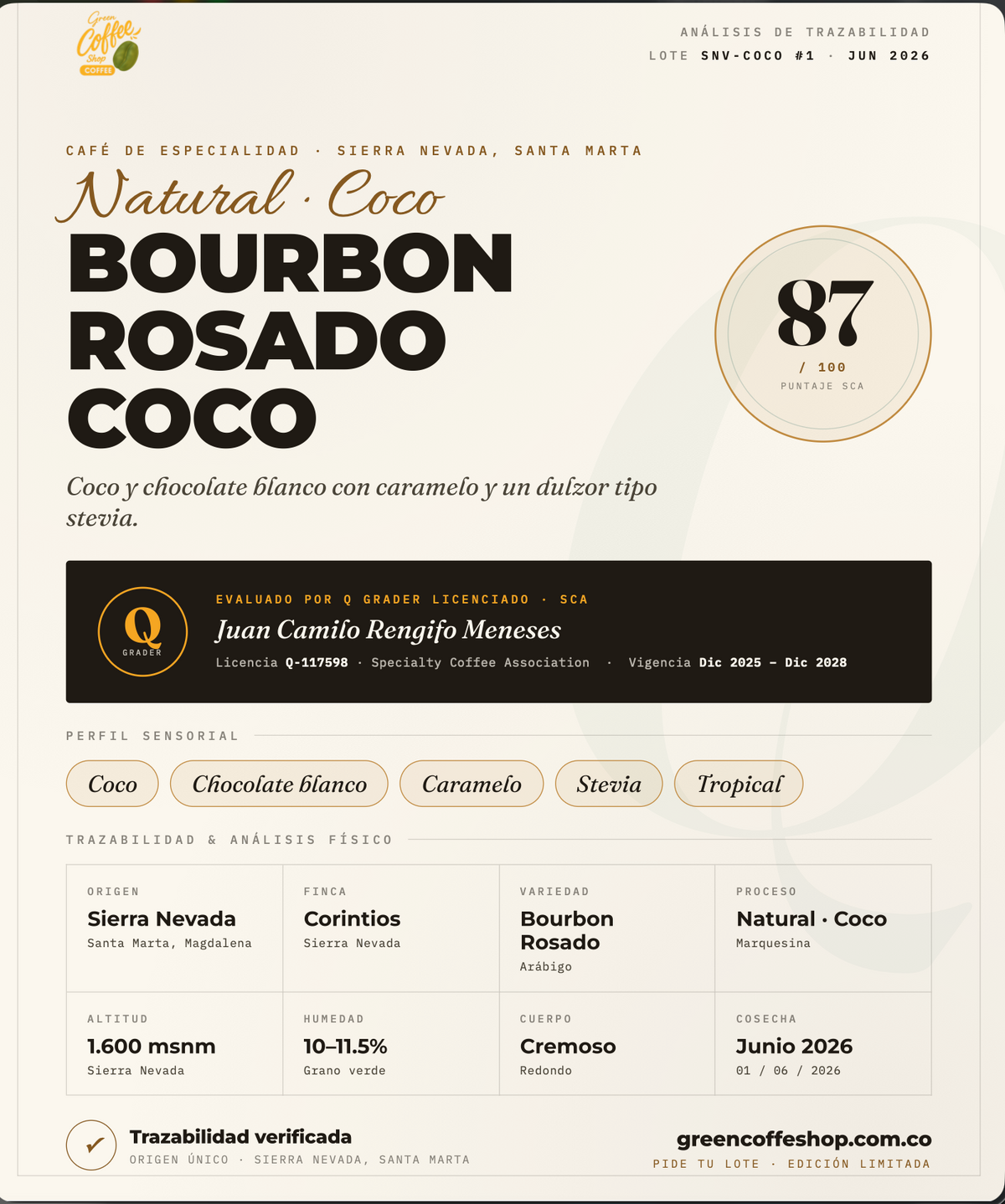
| Pink Bourbon Washed · San Agustín, Huila (microlot) | $85.000 | $76.500 | $68.000 |
| Geisha Natural · Cauca (microlot) | $95.000 | $85.500 | $76.000 |
Excelso (screen 16) and Supremo (screen 18) grades are on request by WhatsApp: we check with the grower first. See all lots at today's green coffee price by lot.
 Geisha Natural · Caucahibiscus · jasmine · blueberry jam · panelaFrom $95.000/kg (1 kg) · $76.000/kg in 35 kg
 Pink Bourbon Washed · HuilaExotic microlotFrom $85.000/kg (1 kg) · $68.000/kg in 35 kg
From the price per kilo to the cup
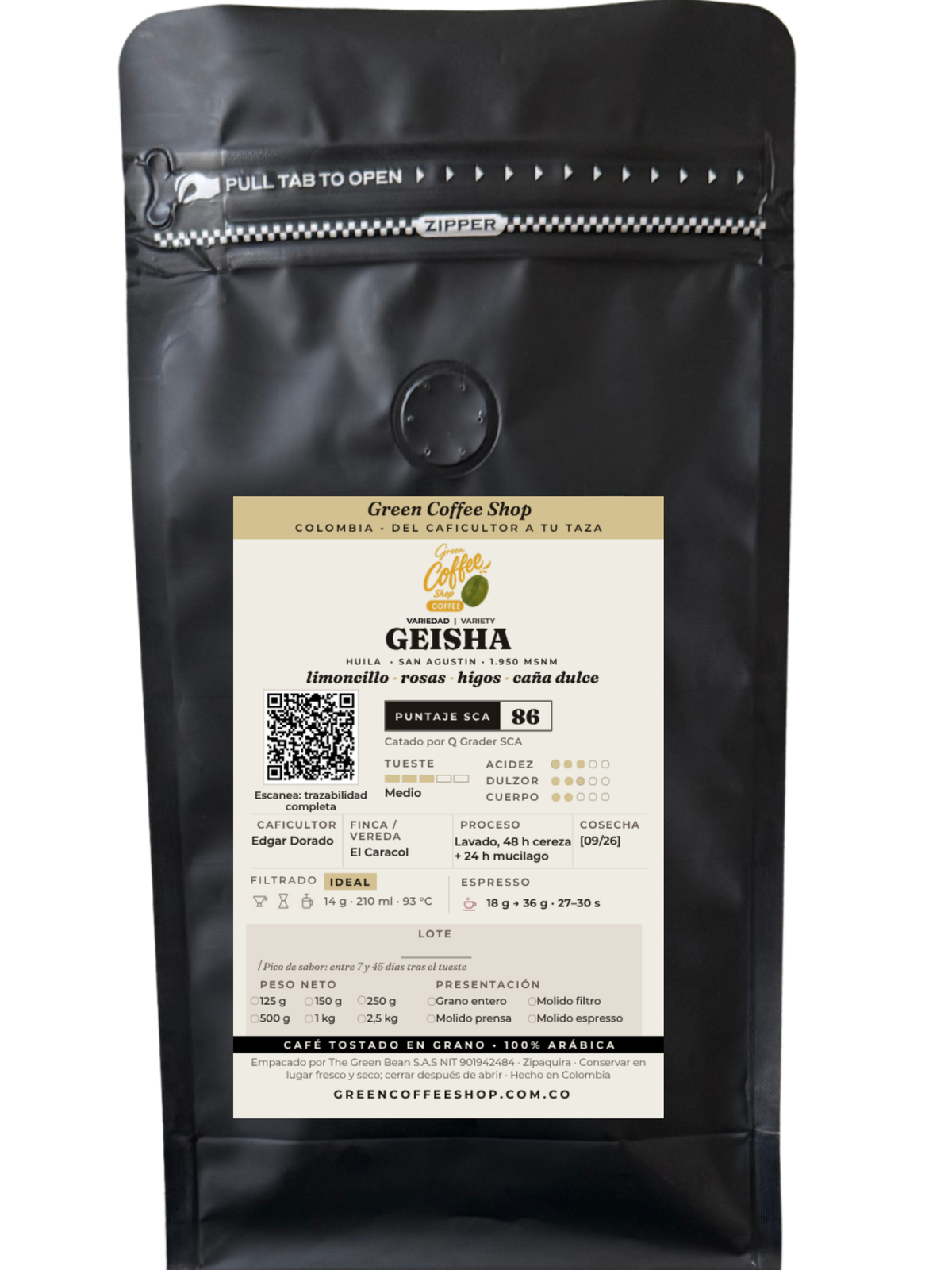
The price per kilo only matters once you turn it into a cost per cup. An example with the filter recipe on our labels (14 g of roasted coffee) and an assumed roast loss of 15 %: 1 kg of green gives 850 g roasted, about 60 cups.
Coffee cost per filter cup (14 g)
- Castillo Washed, 35 kg: $48.900 ÷ 60 ≈ $800 per cup
- Castillo Washed, 1 kg: $61.000 ÷ 60 ≈ $1.000 per cup
- Pink Bourbon Washed, 1 kg: $85.000 ÷ 60 ≈ $1.400 per cup
- Geisha Natural, 1 kg: $95.000 ÷ 60 ≈ $1.600 per cup
How to compare two green coffee offers?
- Put both in the same unit. Pesos per kilo of milled green bean. If you're offered parchment, divide by the kilos the load yields at its factor.
- Ask for the factor. For the same load, factor 88 yields 99.4 kg of green bean and factor 94 yields 93.1 kg: a 6.3 kg difference.
- Ask for the screen size and moisture. UGQ, Excelso and Supremo aren't the same product; green coffee moisture is usually requested between 10 and 12 %.
- Ask for traceability. Coffee grower, municipality, altitude, variety and process. If nobody knows who grew it, you can't repeat the lot.
- Roast a sample before the sack. A sample of 200 g to 1 kg with your usual profile tells you more than any spec sheet.
Comparing suppliers? Get a quote from us
- Milled lots from Huila and Sierra Nevada, by the kilo or by the sack.
- Calibration kit of 200 g to 1 kg per origin: its value is credited to your first green coffee order.
- Lot sheet with coffee grower, variety and process.
Frequently asked questions
What is the price of green coffee today in Colombia?
The FNC reference price on 29 October 2026 was $2.025.000 per 125 kg load of dry parchment coffee at factor 94, about $21.800 per equivalent kilo of green bean. Green coffee that's already milled and graded by screen size sells for more: in our store, from $46.400/kg in a 35 kg sack.
What's the difference between parchment coffee and milled green coffee?
Dry parchment coffee keeps the husk that wraps the bean; it's what the coffee grower sells and what the FNC quotes. Milled green coffee no longer has that husk and is graded by screen size. Roasters buy milled green coffee, because that's what goes into the roaster.
How much does a kilo of specialty green coffee cost?
At The Green Coffee Shop Colombia, a kilo of UGQ milled green coffee costs $61.000 for Castillo Washed, $85.000 for Pink Bourbon Washed and $95.000 for Geisha Natural (prices as of 13 November 2026, 1 kg). The price per kilo goes down at 5, 12 and 35 kg; Excelso and Supremo are on request by WhatsApp.
Why does the price of coffee change every day?
Colombia's domestic reference price for coffee is calculated daily from the New York exchange close, the dollar rate and the Colombian coffee differential. If the exchange or the dollar moves, the load changes. Specialty coffee is also traded on quality, variety and process.
How do I convert the price per load into a price per kilo?
Work out how much green bean the load yields: 125 kg ÷ factor × 70. At factor 94 that's 93.1 kg. Then divide the price of the load by that number. At $2.025.000, the equivalent kilo of green bean comes to about $21.800, before milling, sorting, transport and packaging.
How much is a load of coffee?
A load of coffee is 125 kg of dry parchment coffee. It's the unit of the FNC's domestic reference price: on 29 October 2026 it was worth $2.025.000, about $16.200 per kilo of parchment. Converted to milled green coffee, a load yields 93.1 kg of green bean at factor 94 and 99.4 kg at factor 88.
What is the best coffee yield factor?
The lower factor is the better one: factor 88 means 88 kg of parchment are enough to get 70 kg of excelso, compared with 94 kg at the factor 94 the FNC uses as its base. A lot at factor 88 yields 6.3 kg more green bean per load and is usually paid at a premium. Factors of 100 or more indicate high loss and are deducted.
Can I try the green coffee before buying a sack?
Yes. You can buy a sample kit for roasters from $48.000, or ask on WhatsApp for a calibration kit of 200 g to 1 kg per origin. The value of the calibration kit is credited to your first green coffee order.
Review
Reviewed by a Q Grader with licence Q-117598 · The Green Coffee Shop Colombia, Zipaquirá, Cundinamarca.



Comments