
How to Buy Green Coffee in Colombia? Complete Guide 2026
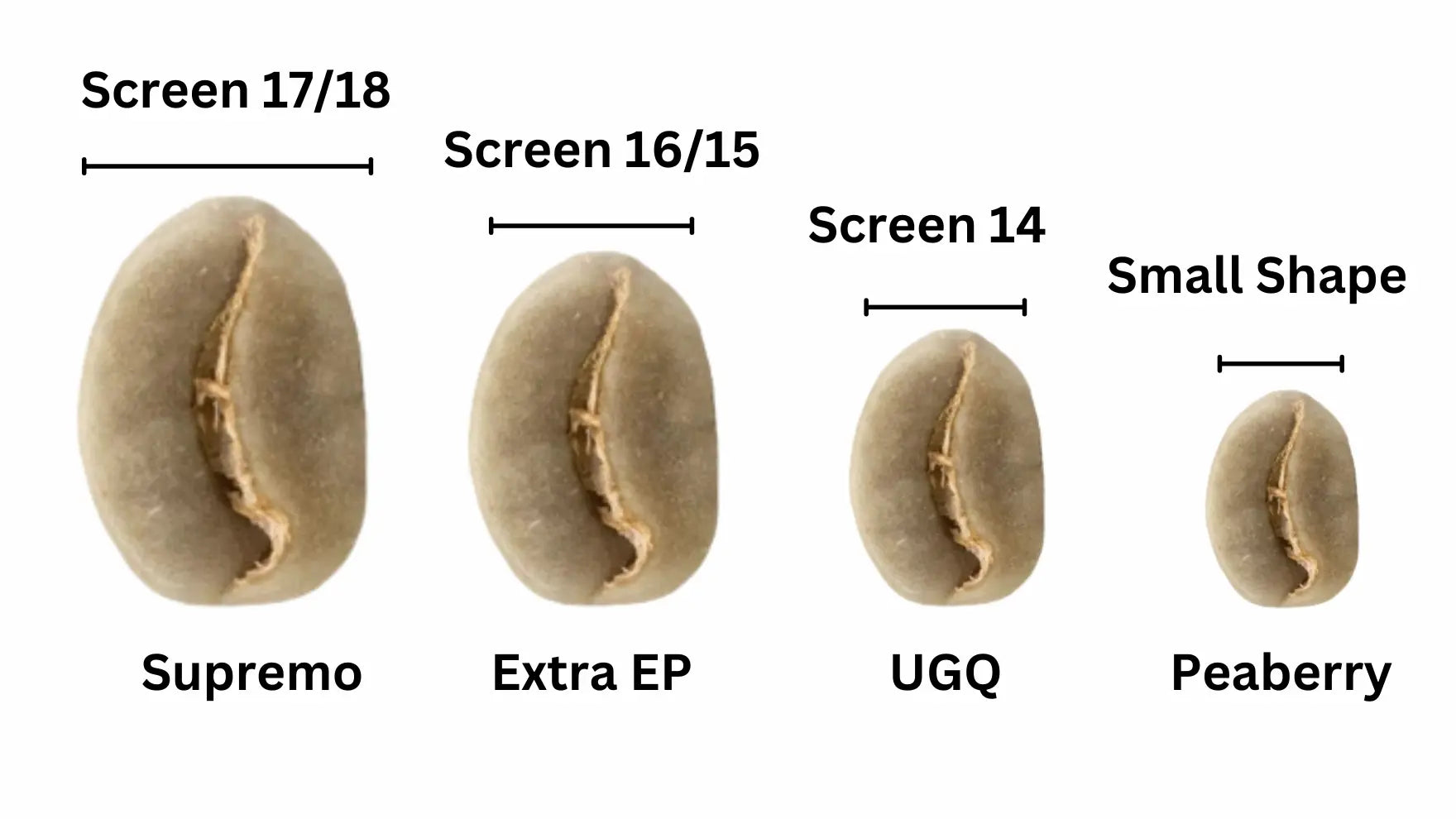
To buy green coffee in Colombia, first choose the screen size that suits your roaster and your profile (UGQ screen 14, excelso screen 15/16 or supremo screen 17/18), ask for the lot sheet (moisture 10–12 %, defects, yield factor) and roast a sample before buying in volume. At The Green Coffee Shop Colombia you can buy from 1 kg, with the coffee grower's name and shipping anywhere in Colombia.
Buy or get a quote for green coffee to roast
Green coffee from $58.000/kg; Excelso (15/16) and Supremo (17/18) on request via WhatsApp. Buying 5 kg or more? We'll quote you a volume price on WhatsApp.
In specialty coffee, the cup score (SCA 80+) rules, but there is a quiet hero that decides whether that coffee will shine or burn in the roaster: bean uniformity.
Whether you are an exporter who has to meet international standards or a roaster chasing the perfect roast curve, understanding the raw material is vital. At The Green Coffee Shop Colombia we sell green coffee in UGQ (screen 14) from stock; Excelso (screen 15/16) and Supremo (screen 17/18) are on request via WhatsApp (we check with the grower first).
What is milled green coffee?
Milled green coffee is the bean once it has been processed (pulped, fermented, washed and dried) but not yet roasted. Unlike parchment coffee, which still has its husk, milled coffee is ready for the roaster: clean bean, moisture between 10 and 12 %, graded by screen size and storable for up to 12 months in good conditions.
What makes a green coffee specialty?
Not all Colombian coffee is the same. To be considered "specialty", a green coffee has to pass a physical and sensory evaluation and score more than 80 points on the Specialty Coffee Association (SCA) scale. But the score isn't everything: physical consistency is what lets you repeat that profile again and again.
The secret of an even roast: screen size
The number-one mistake when buying green coffee is ignoring bean size (malla, or screen size). If you mix large and small beans in the same batch, the small ones roast faster, even burn, while the large ones stay raw in the centre. With lots graded by screen size, heat penetrates every bean equally.
| Grade | Screen | How it behaves | Ideal for |
| UGQ (Usual Good Quality) | 14 | Smaller but dense beans | Bold blends and roasters looking for versatility and price |
| Excelso | 15/16 | Balanced, consistent bean | The export standard importers in Europe and the United States ask for |
| Supremo | 17/18 | Large beans with very even roast development | Limited editions and premium markets |
To get started (price per kg, 1 kg)
 Regional AA Washed · Huila
$63.000 / kg
 Yellow Caturra Washed · Huila
$70.000 / kg
 Geisha Natural · Huila
$115.000 / kg
Want to calibrate before buying volume? Ask on WhatsApp for a calibration kit of 200 g to 1 kg: its value is credited to your first order.
How much does green coffee cost in Colombia?
Prices per kilo in our store (1 kg, updated 13 November 2026). At 5 kg and 12 kg the price per kilo goes down.
| Lot type | Examples | Price per kg (1 kg) |
| Premium commercial, washed | Blend, Castillo, Caturra, Colombia, Regional AA | $58.000 – $70.000 |
| Exotic microlots | Pink Bourbon, Tabi, Papayo, Geisha, Laurina | $76.000 – $144.000 |
| Co-fermented (culturing) | Bourbon Rosado Coco | $174.900 |
The price per kilo isn't the only cost: the yield factor decides how much sound coffee you actually get. Read yield factor: what it is and how much it yields or use the cost and profitability calculator.
Coffee varieties: cup profiles
Once the right screen size is secured, the next step is the botanical variety:
| Variety | Typical flavour profile | Acidity and body | Ideal for |
| Caturra | Bright citrus, green apple | Medium-high acidity, medium body | The classic mild Colombian profile |
| Castillo | Fruity notes, chocolate, nuts | Balanced acidity, silky body | Roasters looking for consistency and sweetness |
| Pink Bourbon | Red berries, caramel, wine | Complex acidity, creamy body | Exotic coffees and filter methods (V60, Chemex) |
| Geisha | Jasmine, floral, tea, tropical fruit | Delicate acidity, light body | Competitions and sensory experiences |
Defects and moisture: what you can't see at a glance
- Controlled moisture (10–12 %): above 12 % the coffee risks mould and a musty taste during transport; below 10 % it loses its aromatic notes and tastes like old wood.
- Milling and sorting: a good supplier should mill and sort to remove primary defects (black, sour or borer-damaged beans) that ruin the cup.
How to check quality before you buy
- Screen size: uniform bean; at least 80 % should pass the stated screen; defects below 5 %.
- Moisture: between 10 and 12 %. Ask for the physical analysis.
- Yield factor: weigh 1 kg of sample before and after milling. A factor of 88 or lower is excellent.
- Roast test: ask for a 200–300 g sample, roast it with your standard profile and judge cleanliness and sweetness.
- Traceability: farm, municipality, department, altitude and variety.
Green coffee FAQs
What is the difference between excelso coffee and specialty coffee? "Excelso" refers to bean size and the exportable physical quality defined by the Federation. "Specialty" refers to sensory quality in the cup (flavour, aroma, SCA score 80+). A coffee can be excelso and specialty at the same time.
Why buy green coffee by screen size (14, 15/16 or 17/18)? Buying a specific screen size, instead of a mixed lot, lets you apply precise heat curves: a supremo screen 17/18 needs a different heat load than a UGQ screen 14. Uniformity means professional quality.
How long can I store green coffee? In a cool, dry place, ideally in hermetic bags such as GrainPro, green coffee keeps its best freshness for 6 to 12 months.
What is the minimum green coffee order? In our store you can buy from 1 kg; at 5 kg and 12 kg the price per kilo goes down, and for larger volumes we quote on WhatsApp.
Ready for your next lot?
Tell us which roaster you use, how many kilos you roast a month and what profile you're after. We'll recommend a screen size and a lot.
Published: 6 February 2026 · Updated: 13 November 2026. What changed: lots, links and store prices per kilo as of 13 November 2026; Excelso and Supremo are now on request via WhatsApp.



Comments