
How to sell your specialty coffee without going through the FNC or intermediaries: 2026 guide for Colombian coffee growers

Six months ago, two coffee growers in Pitalito received almost identical cupping results: 86 SCA points, washed Pink Bourbon variety, similar altitude, same process. One sold his lot to the cooperative at the day's domestic price. The other listed it as a microlot through an online roaster-retailer. The difference in income for the same harvest was close to 2.5 times.
It isn't magic. It isn't luck. It's the result of understanding that Colombia's traditional coffee marketing system was designed for commodity coffee with a yield factor of 94 — and that your specialty coffee deserves another route. This guide honestly explains how the price you receive today is set, what three real paths you have to sell your harvest, and how the direct-to-consumer model that is changing the supply chain for Colombian specialty coffee works.
The problem: you're paid for physical yield, but your cup profile is ignored
The domestic reference price published daily by the Federación Nacional de Cafeteros (FNC) is calculated assuming a coffee with a yield factor of 94. We know that if you deliver coffee with a yield factor of 88 or 90, the cooperative applies a re-settlement table and pays you an extra bonus because your coffee yields more exportable green bean. Up to that point, the system works.
But here's the specialty coffee trap: the traditional system pays you a premium for physical yield, but completely ignores your sensory profile. If that same factor-88 coffee also scores 86+ on the SCA scale, has exotic fruit notes and impeccable traceability back to your vereda, you're leaving a great deal of value on the table.
Buyers who value the cup — specialty roasters, microlot exporters, end consumers — are willing to pay 1.5x to 3x the domestic price. But only if they can find your coffee, verify your quality and trust your story.
The three real routes to sell your specialty coffee in Colombia
Every coffee grower basically has three paths to sell their harvest. Each route has advantages and hidden costs. What matters is understanding them honestly so you can decide which one suits your farm.
Route 1: Cooperative or FNC purchase guarantee
The traditional model: you take your parchment coffee to the buying point, they apply the table according to your yield factor, and they pay you the day's price plus your physical bonus. You get the money immediately.
Real costs: Your specialty coffee — the one you stayed up nights over, watching the fermentation — ends up mixed in a giant silo with average coffees. The end buyer will never know who you are, and you lose for good the chance to build your farm's name.
Route 2: Intermediaries, Exporters and "Forward Purchases"
This is where independent buyers, traditional exporters and the well-known forward purchase come in. In this model, a buyer negotiates directly with you for a large volume, fixing a price for your lot before or during the harvest.
Real costs: Although forward purchases protect you if the exchange price falls, they make you lose control. They buy volume, set the price to suit themselves and capture the whole margin when they resell abroad. By handing over your whole lot under this model, you lose the chance to be part of the new D2C (Direct to Consumer) sales technologies, giving up the right to decide the price your microlot is really worth.
Route 3: Direct sale to an online roaster-retailer (Agro-Tech)
The emerging model transforming the chain: you sell your coffee directly to an e-commerce agricultural technology company that evaluates your lot, roasts to order, packs it with your farm's name and sells it online to the end consumer.
Advantages: Instead of tying yourself to a forward volume contract, you propose the price based on your coffee's quality (SCA). You achieve a significantly higher margin (1.5x to 3x), your name goes on the bag, and you get access to cutting-edge technology to sell without murky intermediaries.
🌾 Are you a coffee grower who wants to stop selling blind?
If you produce specialty coffee (84+ SCA), we help you connect it with roasters and consumers. Forget volume contracts that punish your margin. We bring the technology and the marketing; you decide what your quality is worth.
Apply to the Coffee Grower ProgrammeThe Agro-Tech role: digitising the specialty coffee chain
For decades, Colombian specialty coffee faced a structural problem: excellent producers ended up mixed in commodity silos or tied to exporters because there was no technological infrastructure to connect them directly with the end consumer. Today that infrastructure exists.
At The Green Coffee Shop Colombia we operate exactly in that space as agro-tech leaders. We're not a traditional exporter looking for volume; we're a technology platform that digitises the supply chain. Our infrastructure includes:
- Blockchain-ready digital cataloguing: We digitise your microlot's data (farm, vereda, variety, process, SCA score, yield factor).
- Digital sales funnels: We use artificial intelligence, Google Ads, Meta Ads and data analysis to find the roasters and consumers looking for exactly the sensory profile you produce.
- Expert evaluation: Access to certified Q Graders who evaluate your coffee under SCA protocols when you join the programme, saving you up to 200,000 COP per independent cupping.
☕ Roasters and Coffee Lovers: Support the direct chain
When you buy our coffee, you're directly funding this technology that empowers Colombian coffee growers, paying them up to 3 times more than the traditional market. Full transparency in every bean.
Shop Roasted Coffee See the Green Coffee Catalogue (B2B)How the real maths compares, with numbers
Let's take a concrete, honest case. A coffee grower in Huila has 30 kg of dry parchment coffee of washed Pink Bourbon, yield factor 88, sensory quality 86 SCA. Let's look at the routes:
FNC / Cooperative route: 30 kg parchment × the day's base price + factor-88 bonus (~39,500 COP/kg) = 1,185,000 COP. Immediate payment, yes. But you lost the value of your 86 SCA points.
Direct Agro-Tech route: The grower proposes the price. For a washed Pink Bourbon at 86 SCA, a reasonable proposal is between 65,000 and 90,000 COP/kg of equivalent milled green coffee. On the 30 kg of parchment (approx. 21 kg green), that produces a payment of between 1,365,000 and 1,890,000 COP.
The difference: up to 700,000 COP extra for the same harvest, plus brand visibility for your farm, in exchange for waiting a few weeks while our technology positions and sells your lot to the end customer.
How to set your lot apart: the essential role of the Q Grader
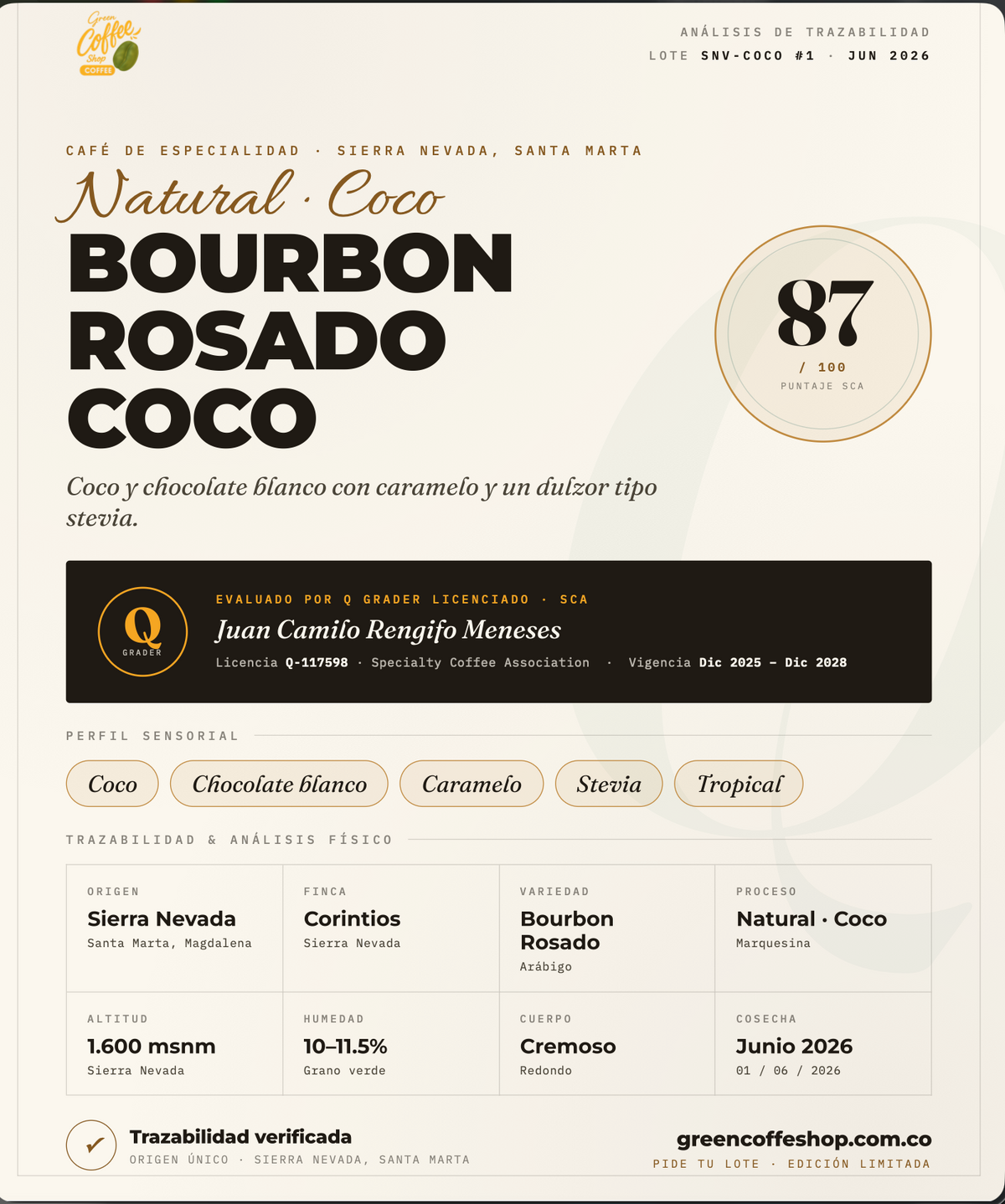
To negotiate the price you want, you need to prove your quality technically. Q Graders are internationally certified cuppers working under Specialty Coffee Association (SCA) protocols. Their evaluation from 0 to 100 points determines whether a coffee is "specialty" (80+) and is the tool that gives you the power to set your price.
If you've already paid for an independent cupping, excellent! Bring that score to the negotiation. If you haven't, when you join The Green Coffee Shop Colombia programme, the evaluation by our partner Q Graders is absorbed into the commercial model. You receive the detailed sensory report and we use it to position your coffee fairly and scientifically on the platform.
Conclusion: your coffee deserves more than a volume price
The traditional system was designed for commodity coffee. Modern intermediaries and forward purchases were designed to control large-scale volumes. Technology-backed direct sales (e-commerce) are the only real way out of that commercial trap.
At The Green Coffee Shop Colombia we already work with more than 15 farms in 5 departments, connecting them with buyers in Colombia, Australia and, soon, Europe.
Does your coffee have the quality but not the visibility? Learn about the Coffee Grower Programme and start with a 3 kg pilot lot. Or if you're a roaster or end consumer, support the agro-tech revolution by buying our green coffee or roasted coffee with guaranteed traceability.


Comments