
Where to buy specialty coffee in Colombia online: how to choose a store and what it costs

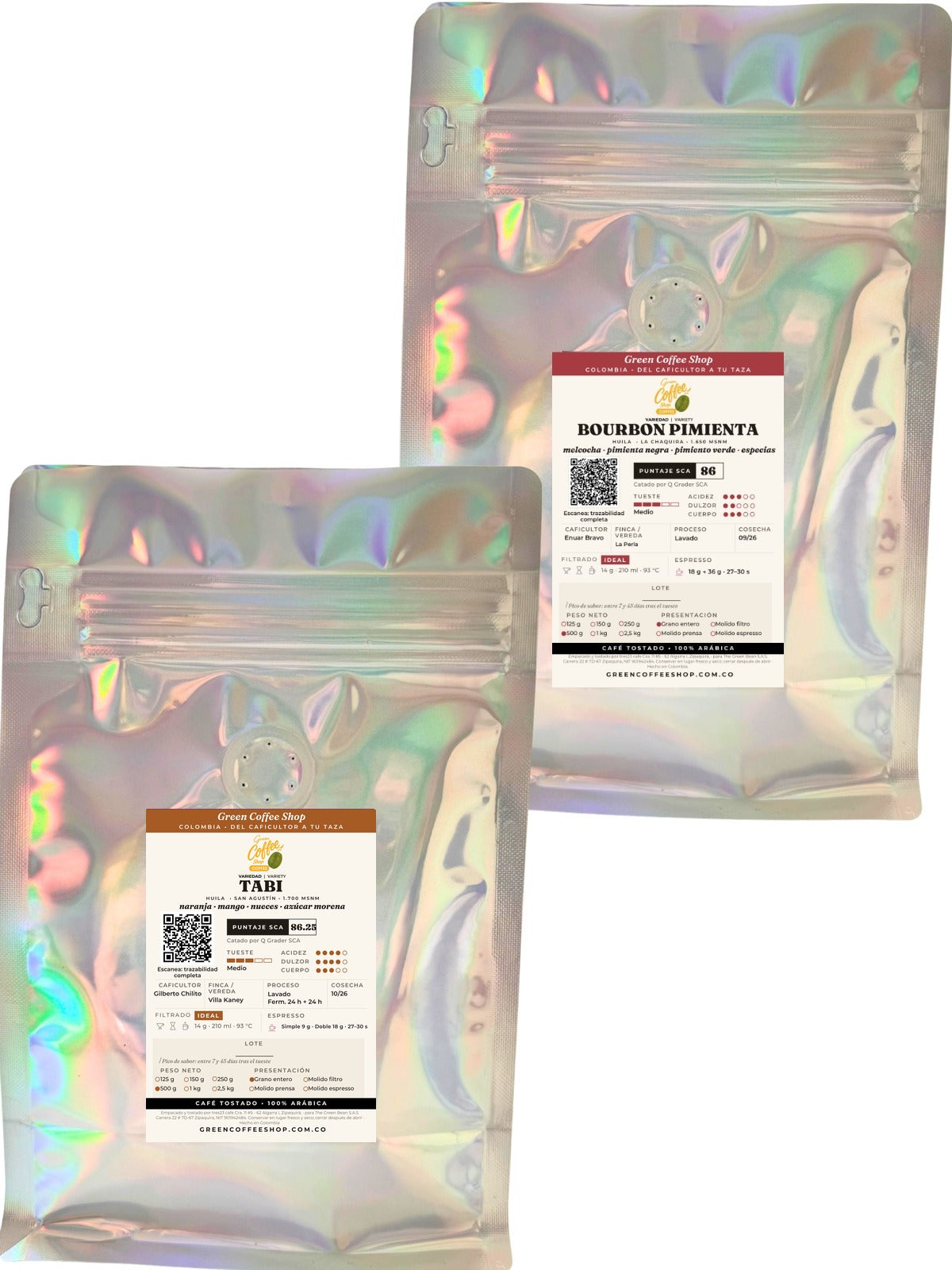
To buy specialty coffee in Colombia online, choose a store that prints on the bag the coffee grower, the farm, the altitude, the process, the SCA score (80 or more) and the roast date; in our review of public prices from 14 Colombian roasters (30 October 2026), a 250 g bag cost between $32.000 and $122.000, and the middle of the group sat at around $52.000 to $55.000. At The Green Coffee Shop Colombia, the washed Papayo from Ricaurte Chilito (finca La Concepción, San Agustín, Huila, SCA 85.5) costs $57.900 for 250 g, with free shipping anywhere in Colombia in 2 to 4 business days (price as of 2 November 2026).
Your first specialty bag
 Papayo Washed · San Agustín, HuilaRicaurte Chilito · La Concepción · SCA 85.5citrus · panela · nuts · grapesFrom $32.800 (125 g) · $57.900 (250 g)
 Colombia + Papayo tasting kit2 × 150 g whole bean, to try two regions side by side$64.900
How can you tell if a coffee is specialty before buying it?
A coffee is specialty when it scores 80 points or more on the Specialty Coffee Association (SCA) 100-point scale and its green bean has no primary defects. That score is given by a trained cupper, which is why it matters that the store says who evaluated it. In an online store you can't smell the coffee, so the label and the product sheet have to do that job for you. This is the checklist we use to review any coffee, including ours:
| What to check | What the sheet or bag should say | Example: our Papayo |
|---|---|---|
| Coffee grower and farm | Name of the person and of the farm or vereda | Ricaurte Chilito · La Concepción |
| Origin and altitude | Municipality, department and masl | San Agustín, Huila · 1,700 masl |
| Variety and process | Specific variety and process (washed, honey, natural…) | Papayo · washed |
| Score and cupper | SCA 80+ and who cupped it (Q Grader licence) | SCA 85.5 · Q Grader licence Q-117598 |
| Harvest and lot | Month/year of harvest and lot code | 09/2026 · SAG-PAP #1 |
| Roast date | Printed date and best-flavour window | Date on the bag · best between 7 and 45 days |
| Tasting notes | 3 or 4 specific notes, not adjectives | citrus · panela · nuts · grapes |
| Recipe | Grams, water, temperature | 14 g · 210 ml · 93 °C |
Papayo · San Agustín, HuilaRicaurte Chilito · citrus · panela · grapes$57.900 (250 g) · $97.600 (500 g)
 Geisha Washed · San Agustín, HuilaEdgar Dorado · lemongrass · roses · figs$68.000 (250 g) · SCA 86.25
 Bourbon Pimienta · HuilaEnuar Bravo · melcocha · black pepper · spices$56.000 (250 g) · SCA 86
What should you look for in an online roaster or store?
In an online specialty coffee store, look at four things: freshness, traceability, shipping and payment method. You've already checked the bean quality with the table above; these four tell you whether the store will deliver it to you in good condition.
- Freshness: the bag should carry the roast date, not just the expiry date. Specialty coffee tastes best between 7 and 45 days after roasting.
- Traceability: a QR code or a sheet that leads to the farm, the coffee grower and the lot analysis. If the page only says "premium coffee from the mountains of Colombia", there's nothing to verify.
- Shipping: how much it costs, where it ships from and how many days it takes, before you reach checkout.
- Payment and exchanges: secure online payment, whether there's cash on delivery in your city and what happens if the parcel arrives damaged.
If you'd like help choosing a profile (fruity, floral, chocolatey), there's a 1-minute quiz in our guide to choosing origin coffee.
How much does specialty coffee cost in Colombia?
Specialty coffee in Colombia costs, in most online stores, between $40.000 and $70.000 for a 250 g bag. Competition lots, Geishas or long fermentations can go above $90.000. To compare stores that sell in 250, 300, 340 or 360 g, bring everything to the same measure: price ÷ grams × 250.
| Tier | COP per 250 g | Cost per cup (14 g) | What it usually is |
|---|---|---|---|
| Entry | $32.000 – $45.000 | $1.800 – $2.500 | Blends, regional coffees or large formats |
| Mid | $45.000 – $60.000 | $2.500 – $3.400 | Single origin with a named farm, washed coffees |
| High | $60.000 – $80.000 | $3.400 – $4.500 | Geisha, Sidra, naturals and fermentation processes |
| Microlot / competition | over $80.000 | over $4.500 | Award-winning lots or very small editions |
Watch the shipping: in that same review, most stores charged shipping separately or only made it free above a certain amount. A cheap bag with $10.000 shipping can end up costing more than a mid-priced one with shipping included. This is where our coffees sit in that table:
| Coffee | Coffee grower · origin | SCA | Notes | 250 g | Method |
|---|---|---|---|---|---|
| Colombia Washed | Adolfo Ruiz · Sandoná, Nariño | 85 | fruity · cacao · brown sugar · berries | $44.300 | Espresso, with milk and filter |
| Bourbon Pimienta | Enuar Bravo · La Perla, La Chaquira, Huila | 86 | melcocha · black pepper · green pepper · spices | $56.000 | Filter and espresso |
| Papayo Washed | Ricaurte Chilito · La Concepción, San Agustín, Huila | 85.5 | citrus · panela · nuts · grapes | $57.900 | Filter and French press |
| Geisha Washed | Edgar Dorado · El Carmen, San Agustín, Huila | 86.25 | lemongrass · roses · figs · sugar cane | $68.000 | Filter |
Colombia + Papayo kitAdolfo Ruiz and Ricaurte Chilito · 2 × 150 g$64.900
 Espresso Kit Colombia + Bourbon PimientaAdolfo Ruiz and Enuar Bravo · 2 × 150 g$63.900
 Colombia Washed · Sandoná, NariñoAdolfo Ruiz · cacao · brown sugar · berries$44.300 (250 g) · SCA 85
What the SCA score tells you and what it doesn't
- What it tells you: 80 points or more on the SCA's 100-point scale is the classic specialty threshold. Below 80, coffee is considered commercial (Royal Coffee, 10 Mar 2026).
- What it tells you: that scale uses tiers. Around 85 or more usually goes to single-origin coffee, and 90 or more is rare.
- What it doesn't tell you: whether you will like the coffee. A floral 86 and a chocolatey 86 are equally good, but they're very different cups. That's what tasting notes are for.
- On the other hand: in 2025 the SCA introduced a new form, the Coffee Value Assessment, which no longer uses the 100-point scale. For now almost every bag still prints the 100-point score. The definition of specialty is moving towards "a coffee recognised for its distinctive attributes".
- What to ask for: that the store says who cupped the lot. Our coffees are cupped by a Q Grader with licence Q-117598.
How far does a bag go and how much is a cup?
A 250 g bag of specialty coffee makes about 18 filter cups of 210 ml with the 14 g recipe. Save this card to compare stores before paying:
Card for comparing before you buy
- Price per 250 g: price ÷ grams in the bag × 250
- Cups per 250 g bag: ≈ 18 (14 g per cup)
- Cost per cup: price of 250 g ÷ 18
- Papayo example: $57.900 ÷ 18 ≈ $3.200 per cup, shipping included
- Colombia example: $44.300 ÷ 18 ≈ $2.500 per cup, shipping included
- Filter recipe: 14 g · 210 ml · 93 °C · 2:30 to 3:00 min
- Espresso recipe (Colombia, Caturra or Bourbon Pimienta): 18 g → 36 g · 27 to 30 s
How to buy your first bag online without getting it wrong?
- Choose the method first. V60, Chemex or French press call for a filter coffee; for espresso or milk drinks, look for one marked for espresso.
- Choose the profile. Fruity (Papayo), floral (Geisha), spiced (Bourbon Pimienta) or chocolatey (Colombia). If in doubt, start with a two-coffee kit.
- Check the sheet against the table above. Coffee grower, altitude, process, SCA, harvest. If half of it is missing, keep looking.
- Compare the price per 250 g and add shipping. What matters is the total you pay per cup.
- Order whole bean if you have a grinder. If not, order it ground for your method.
- Check the roast date when it arrives. Brew it between day 7 and day 45, and keep it tightly closed in a cool, dry place.
Whole bean or ground?
Buy whole-bean specialty coffee if you have a grinder: ground coffee loses aroma faster, and grinding just before brewing shows in the cup. If you don't have a grinder, order it ground for your method (filter, French press or espresso), because each one calls for a different grind size. We sell all our coffees whole bean or ground.
How long does shipping from Zipaquirá take?
Roasted coffee and kits ship from Zipaquirá (Cundinamarca) and arrive in 2 to 4 business days anywhere in Colombia, with free shipping. Confirmed orders ship the same business day or the next, and you receive the tracking number by email or WhatsApp. In Bogotá and Cundinamarca you can also pay cash on delivery for orders of up to $300.000, with a fixed $5.000 collection fee.
Start with a two-coffee kit
- Colombia from Adolfo Ruiz (Sandoná, Nariño, SCA 85) and Papayo from Ricaurte Chilito (San Agustín, Huila, SCA 85.5).
- 2 bags of 150 g whole bean, to cup them side by side and find out which profile you like.
- Free shipping anywhere in Colombia, in 2 to 4 business days.
Frequently asked questions
How can I tell if a coffee is specialty?
A coffee is specialty if it scores 80 points or more on the SCA's 100-point scale and its bean has no primary defects. When buying online, look for it on the bag or the sheet: coffee grower and farm, altitude, process, SCA score, who cupped it and roast date. If that information isn't there, there's no way to verify it.
How much does specialty coffee cost in Colombia?
In Colombian online stores, a 250 g bag of specialty coffee almost always costs between $40.000 and $70.000; in our review of 14 roasters (30 October 2026) the full range was $32.000 to $122.000. At 14 g per cup, a 250 g bag gives about 18 cups, so each cup costs between $2.200 and $3.900.
Is it better to buy specialty coffee whole bean or ground?
Whole bean, if you have a grinder. Ground coffee loses aroma faster, and grinding just before brewing better preserves the notes on the bag. If you don't have a grinder, order it ground for your method: filter, French press or espresso each call for a different grind size. At The Green Coffee Shop Colombia we sell all our coffees whole bean or ground.
How long does a specialty coffee order take to arrive?
Our roasted coffee and kit orders ship from Zipaquirá, Cundinamarca, and arrive in 2 to 4 business days to any city in Colombia, with free shipping. We dispatch the same business day as confirmation or the next and send you the tracking number by email or WhatsApp. With other stores, check the time and cost before paying.
Can I pay for the coffee cash on delivery?
Yes, in Bogotá and Cundinamarca. At The Green Coffee Shop Colombia cash on delivery applies to orders of up to $300.000 and 5 kg, with a fixed $5.000 collection fee that you pay the courier together with the order. In the rest of the country you pay online at checkout. If you have questions, message us on WhatsApp.
How long does specialty coffee stay fresh?
Roasted specialty coffee tastes best between 7 and 45 days after roasting. That's why it pays to buy from a store that prints the roast date on the bag, not just the expiry date. Keep it in its bag tightly closed, away from light, heat and moisture, and grind it just before brewing.
Review
Reviewed by a Q Grader with licence Q-117598 · The Green Coffee Shop Colombia, Zipaquirá, Cundinamarca.


Comments