
How to choose specialty coffee for your café in Colombia
By The Green Coffee Shop Colombia team.
Quick answer: To choose specialty coffee for your café, test the coffee with your equipment and your menu before buying volume. Compare flavour, ease of dialling in, consistency between deliveries, availability and cost per drink. Ask the supplier for the commercial terms in writing.
This guide focuses on cafés, restaurants and businesses that buy roasted coffee ready to brew. If your business roasts its own coffee, you'll need to evaluate green coffee and roasting costs separately.
1. Define what your menu needs
Before contacting suppliers, record which drinks you sell, how many you make and what your customers expect. A bar coffee for espresso and cappuccino has a different job from a rotating microlot for filter.
- House coffee: look for a repeatable profile that works in your best-selling drinks.
- Exploration offer: consider a second coffee that brings a different experience and that you can explain.
- Operating capacity: check whether your team can dial in and maintain several options without increasing waste too much.
A blend or a single origin can both be valid options. Evaluate the result and the lot information; the format on its own doesn't guarantee quality.
Single-origin roasted coffee for cafés: how to bring it in
A coffee from an identified farm or region can give your menu a concrete story and a distinctive profile. To select an origin coffee supplier, ask for the lot's identification, profile, roast date and a procedure for replacing it when it runs out. A microlot may be limited: confirm continuity before making it your house coffee.
Single origin for the bar or as a seasonal filter?
Try both possibilities depending on your menu. For the bar, evaluate espresso repeatability and the result with milk. For a seasonal filter, test small portions, record its cost and prepare an explanation of the producer, process and flavour. A lot with different notes can complement the house coffee without requiring the whole menu to change.
How to buy roasted coffee by the kilo for a café?
Ask for a quote that identifies the lot and weight, and includes the final price, applicable taxes, shipping, minimum order and lead time. Don't assume a 1 kg bag includes a wholesale rate or guarantees restocking. Compare the cup test first and then the cost per drink.
What to ask a specialty coffee supplier in Colombia
Request a sample or trial order, traceable lot information, a brewing recommendation and supply terms. To explore a specific origin, look at the washed Bourbon Ají from Pitalito, Huila; confirm it suits your menu and is available before buying volume.
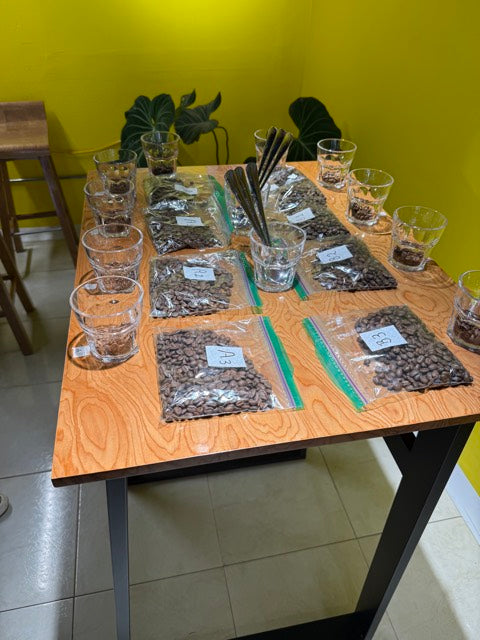
2. Run a test before buying volume
- Request a trial quantity and the lot information, roast date and recommended rest.
- Use the business's usual machine, grinder, water and milk.
- Record the coffee dose, drink weight, time and grinder adjustments.
- Evaluate the straight espresso and the main drinks on the menu.
- Note the coffee used for dialling in and the drinks thrown away.
- Repeat the evaluation on another shift to check the team can reproduce it.
Extraction time is a reference point for a recipe; it isn't a universal quality criterion. The result in the cup and service consistency should guide adjustments.
To shortlist candidates, see our coffees for espresso. If the business offers filter coffee, also compare profiles in the roasted coffee catalogue.
3. Compare suppliers with the same checklist
| Criterion | What to ask | What to record |
|---|---|---|
| Traceability | What information identifies each lot? | Origin, process, profile and lot available. |
| Consistency | How do they handle lot or profile changes? | Advance notice and test procedure. |
| Supply | What are the lead time and minimum order? | Dates, quantities and restocking options. |
| Price | Does the quote include taxes and shipping? | Final cost and how long the offer is valid. |
| Support | What help do they offer for dialling in? | Scope, channel and cost, if any. |
| Issues | How do I report a delivery or quality problem? | Terms and who handles it. |
A low price per kilo can lose its appeal if the coffee needs a lot of dialling in or if a delay interrupts service. Compare the real cost of operating with each option.
4. Work out the coffee cost per cup
Dose cost = bag price ÷ grams in the bag × grams used per drink.
Illustrative example: a 1.000 g bag at $80.000 COP and an 18 g dose cost $1.440 COP of coffee per drink. The price in the example is not a catalogue offer.
The theoretical yield is 1.000 ÷ 18 = about 55 full doses, before dialling in and waste. To measure your real yield, divide the cost of the coffee used over a period by the drinks sold that used that coffee.
Add milk, other ingredients, cups and operating expenses to calculate the total cost and assess the selling price. The cost-per-cup calculator can help you explore the coffee component; check which items it includes.
5. Plan supply around your real consumption
For example, 40 drinks a day using an 18 g dose need 720 g a day. For 26 operating days, that's 18.72 kg before dialling in and losses. Add the doses for other drinks and measure your waste to set the order.
Agree the delivery frequency based on consumption, storage space and the supplier's lead times. There's no single inventory buffer for every business: adjust the margin to how variable your sales are and to the restocking time.
6. Prepare a useful quote request
Send the supplier: delivery city, estimated consumption in kg, main drinks, machine and grinder, desired profile, order frequency and start date. Ask them to confirm the final price, minimum quantities, availability, lead times and support.
See The Green Coffee Shop Colombia's solutions for cafés. Confirm the current terms before committing to an order; availability and prices can change.
Frequently asked questions
Which coffee is best for cappuccino?
The one that gives a pleasant result with the milk, recipe and drink size your business serves. Evaluate it in the complete drink before choosing.
Should I buy whole bean or ground coffee?
For a bar with a grinder, whole bean lets you adjust the grind during service. If you don't have a grinder, confirm the grind for your equipment with the supplier and buy according to your consumption.
Is it worth offering several coffees from the start?
It depends on the menu, the team and the volume. Start with the options you can brew and maintain consistently; add variety once you can measure its demand and cost.
How do I choose between roasted and green?
Buy roasted if you need to brew drinks directly. Buying green requires roasting capacity and evaluating equipment, losses, quality control and costs separately.
Take the next step with a test
Shortlist candidates among the coffees for espresso, prepare an evaluation sheet and see the solutions for cafés. A documented test will give you a more useful basis for deciding than the price per kilo alone.


Comments