Is Fruit the Right Way to Co-Ferment Coffee? Why Yeast Inoculation is the Gold Standard (2026 Technical Guide)
A specialty roaster in Kuwait recently ordered our Bourbon Rosado Coco. A lead in Dubai asked for rum-barrel-aged coffee. Neither request was random — Middle East premium markets are actively sourcing experimental Colombian processing, and the questions they're asking are getting sharper. But there's a debate splitting the specialty coffee industry right now that most buyers haven't caught up to: is adding fresh fruit actually the right way to co-ferment coffee?
This guide argues honestly that yeast inoculation has become the gold standard — and that some of the most compelling "exotic" flavor profiles from Colombia (like the coconut notes in our Bourbon Rosado from Sierra Nevada) come from variety and terroir with controlled fermentation, not from adding coconut to the tank. If you're a roaster, importer, or specialty café owner sourcing from Colombia, understanding this distinction changes what you should be paying for.
The debate splitting specialty coffee right now
Walk any specialty trade show in 2026 and you'll hear the same argument in different accents. On one side are producers and roasters championing co-fermentation with fresh fruit — passionfruit, blueberry, mango, coconut — as the next frontier of flavor. On the other side are technical producers, researchers, and increasingly discerning importers arguing that fresh fruit co-fermentation is scientifically shaky, environmentally wasteful, and commercially unreliable.
The Hachi Coffee Project, a pioneer in experimental processing, recently published data that landed like a bomb: only 3% of the fruit used in co-fermentation actually ends up in the cup. Most of the "fruit" flavor experienced by cuppers isn't coming from the fruit at all — it's coming from the microbial activity happening during fermentation, which produces the same aromatic esters whether fresh fruit is present or not.
This finding, combined with the growing sophistication of Middle Eastern, Korean, and North American premium buyers, is reshaping the category. Roasters staking their menus on "co-ferments" are increasingly being asked technical questions their producers can't answer. And the honest answer to many of those questions is: yeast is doing most of the work; the fruit is largely theater.
What co-fermentation actually is (and isn't)
Technically, co-fermentation is the addition of external organic substrates — fruits, spices, herbs, selected yeasts — during the coffee's fermentation phase. Timing matters: the addition happens while microbial activity is occurring on the bean's mucilage, not after.
This distinguishes co-fermentation from two related but different practices:
- Post-process infusion: adding aromatics to already-roasted coffee. This is "flavored coffee," not specialty coffee — and increasingly disclosed under transparency labeling.
- Barrel-aging: green beans placed in barrels previously used for spirits (rum, whiskey, wine) absorb residual aromatic compounds. There's no active fermentation — it's aromatic aging. Different category entirely.
Within co-fermentation itself, there's a spectrum that most buyers haven't been taught to see.
The three levels of co-fermentation control
Industry specialists today classify co-fermentation processes into three levels based on the degree of microbiological control. Understanding these levels helps you, as a buyer, ask the right questions of any producer.
Level 1 · Yeast inoculation only (the gold standard)
The producer inoculates the fermenting coffee mass with a specific commercial yeast strain — Saccharomyces cerevisiae, Lachancea thermotolerans, Pichia fermentans, or controlled combinations. These strains have been developed specifically for coffee by laboratories like Lallemand and Scott Laboratories, adapted from the wine and beer industries.
Technical advantages:
- Batch-to-batch reproducibility: the same sensory profile in next year's harvest if conditions are maintained.
- Microbial risk control: the selected yeast dominates fermentation and outcompetes undesirable organisms (Enterobacteriaceae, molds) that cause ferment defects.
- Predictable timing: the producer knows exactly when to stop fermentation through pH, Brix, and time measurement.
- Scalability: consistent volumes for clients who need continuity across seasons.
Level 2 · Yeast inoculation + measured substrate
The producer adds both a selected yeast and an external substrate (fruit concentrate, cacao pulp, reduced juices, specific honey). The yeast controls fermentation while the substrate contributes additional aromatic compounds.
Technically defensible if:
- The substrate is standardized (concentrate with measured Brix, not fresh fruit by eye).
- Dosing is done by weight relative to coffee mass.
- Time, temperature, and pH are documented throughout.
- Reference cuppings are performed lot-by-lot to verify consistency.
Level 3 · Fresh fruit co-fermentation without inoculation (the problematic level)
The producer adds whole or chopped fresh fruit — passionfruit, blueberry, grape, coconut, papaya — without inoculating selected yeasts, without pH control, without soluble solids measurement. The natural microflora on the fruit is relied on to "guide" fermentation.
This is where the honest problems emerge:
- Fruit seasonality: January passionfruit has different Brix, different pH, and different microflora than July passionfruit. Same process, different result.
- Impossible-to-measure quantities: how many grams of fresh blueberry are "enough"? Without weight-based dosing or measurable concentration, each lot is a new experiment.
- Uncontrolled microbial risk: fresh fruit brings its own microbial load, some beneficial, some not. Over-fermentation, acetic defects, vinegar or compost off-notes are real risks.
- The 3% question: if research shows only 3% of the fruit actually reaches the cup, why take on all the variability risk?
The coconut problem: why fresh coconut co-fermentation is chemically higher-risk
Coconut deserves its own section because it's the substrate that presents the most stability problems, and yet it's one of the most requested in premium markets. The reason is chemistry.
- Coconut flesh contains a high proportion of medium-chain saturated fatty acids (lauric acid, caprylic acid, myristic acid) that are prone to hydrolysis and oxidation under microbial activity.
- When coconut fat combines with prolonged fermentation, lipase enzymes produced by microorganisms break triglycerides into free fatty acids and glycerol, generating hydrolytic and oxidative rancidity.
- The breakdown products — butyric, caproic, and caprylic acids — produce intense off-flavors: soapy, rancid, sharply sour notes that no buyer wants.
- Without strict moisture control (ideally below 0.06%), oxygen management, and time discipline, microbial activity on coconut flesh progresses rapidly toward deterioration.
So how do you deliver coconut notes to a buyer who wants coconut notes, without the risk of fresh coconut co-fermentation? The professional answer surprises most people.
💡 The insight most producers miss
You don't need to add coconut to get coconut notes. Certain arabica varieties — particularly Bourbon Rosado grown at altitude in Sierra Nevada de Santa Marta terroir — naturally develop coconut, white chocolate, and tropical notes during controlled natural processing.
The perceived "coconut" flavor comes from lactones and specific ester compounds generated during yeast-driven mucilage fermentation of these varieties, not from any added coconut substrate.
This is why we chose a Natural-process Bourbon Rosado from Finca Corintios (Sierra Nevada) as our coconut-forward lot — instead of adding coconut and hoping it survives fermentation without rancidity, we let the variety, altitude, and terroir do the work.
Bourbon Rosado Coco · Sierra Nevada · Our answer to the co-fermentation debate
🥥 Bourbon Rosado Coco · Finca Corintios · Sierra Nevada
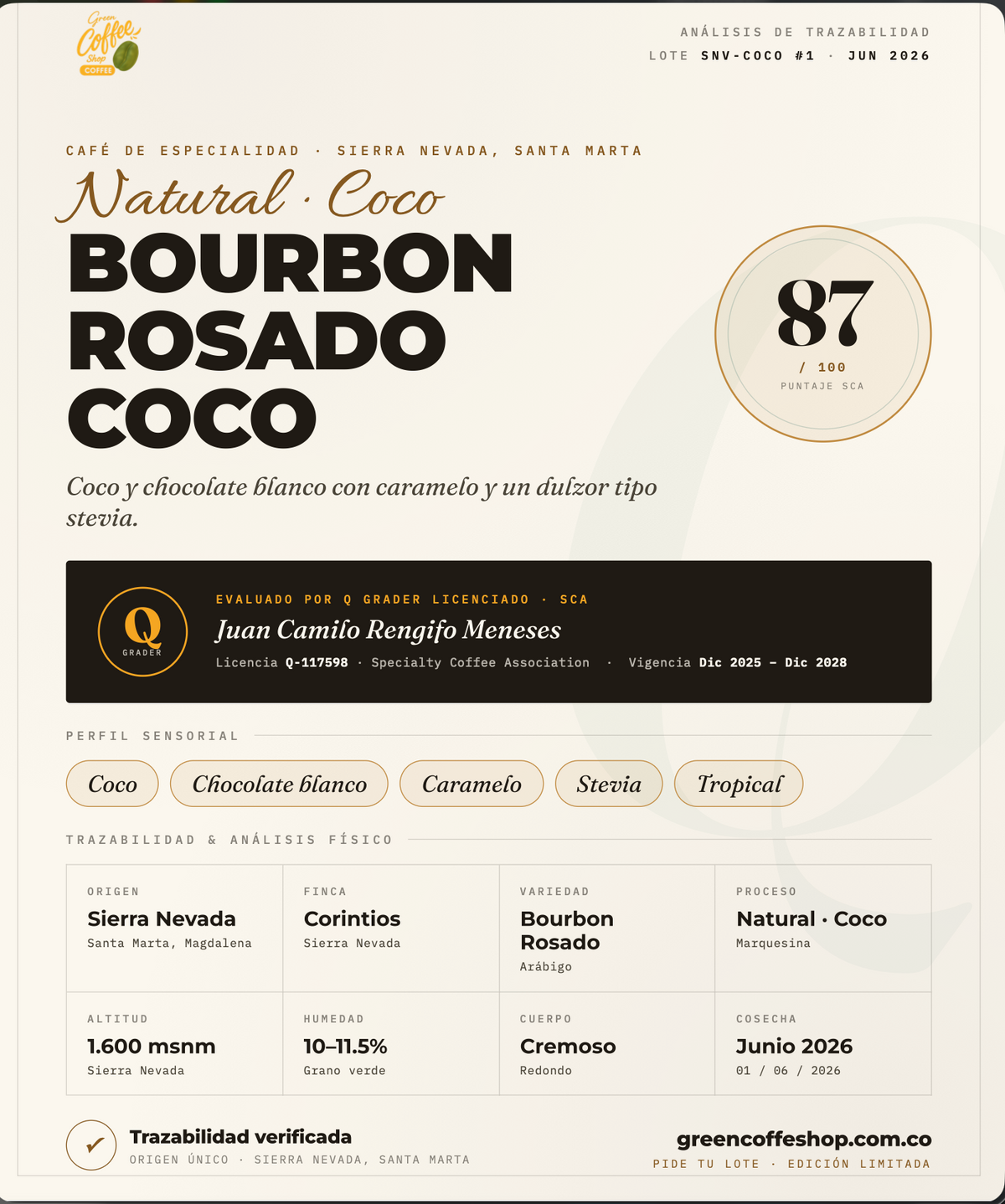
Process: Natural process (whole cherries dried) on marquesina raised beds under canopy. Yeast-driven mucilage fermentation during natural drying. No added fruit, no coconut substrate, no artificial ingredients. The coconut, white chocolate, and caramel notes come from the Bourbon Rosado variety expressed through Sierra Nevada terroir at 1,600 msnm.
Sensory profile (Q-grader evaluated): Coconut, white chocolate, caramel, stevia-like sweetness, tropical notes. Creamy round body. Balanced medium acidity, pronounced natural sweetness.
Lot code: SNV-COCO #1 · June 2026 · Single origin, verified traceability
Status: Available now as roasted (250g retail bags) and green (B2B samples and volume).
🔬 Why this is the more defensible technical position
When a Middle East buyer asks "how do you produce your coconut coffee?", most producers describe adding coconut to the fermentation tank — a process that carries real risk of rancidity, batch inconsistency, and off-flavors as we explained above.
Our answer: we don't add coconut. We selected a variety (Bourbon Rosado) and terroir (Sierra Nevada at 1,600 msnm) that naturally develops coconut and white chocolate compounds during yeast-driven mucilage fermentation on marquesina raised beds. The result is verified at 87 SCA by a licensed Q-grader, with single-origin traceability to Finca Corintios.
This is the difference between adding an ingredient and expressing terroir.
Seven technical questions every serious buyer should ask before purchasing an "exotic" lot
Whether the lot is co-fermented, barrel-aged, or naturally processed, these are the seven questions that separate technical producers from artisanal ones:
- What variety is it, and where is it grown? Variety + terroir + altitude is where most flavor originates. If the producer can't tell you the specific variety and finca, everything else is marketing.
- Is fresh fruit added? If yes, why? If the notes come from variety and terroir, added fruit is unnecessary and adds risk. If added, ask about substrate form (fresh vs concentrate) and dosing method.
- What yeast strain, if any? Named strains (Lallemand, Scott Labs, specific Saccharomyces cerevisiae) show technical control. "Natural yeast from the cherry" means uncontrolled wild fermentation.
- What measurements were documented during fermentation? pH, temperature, Brix, time. No data means no reproducibility.
- How was fermentation duration determined? Extended fermentations without technical justification are a red flag.
- Is there a Q-grader SCA report per lot? Lot-by-lot Q-grader evaluation is the professional standard. Ask for the licensed grader's name and license number.
- Can you replicate this profile next year? If the answer is "each harvest is unique," you're buying an unrepeatable experience — fine for a competition lot, bad for building a permanent menu.
🌍 Working with international roasters, importers, and specialty cafés
We work with buyers in Colombia, Australia, and — through our direct trade program — with specific importers in Kuwait, UAE, South Korea, and the United States. Every lot we offer includes:
- Complete technical documentation per lot: moisture, screen size, defect count, SCA score, licensed Q-grader report with license number, single-origin traceability to producer name and finca.
- B2B sample program: 500g sample packs for profiling before volume commitment.
- Harvest reservation (forward contracting): price locked up to 6 months with fractional monthly shipments.
- Direct trade traceability: producer name, farm, vereda, municipality, altitude, harvest date.
Bottom line: co-fermentation is a tool, not a shortcut
The specialty coffee industry has spent five years pushing co-fermentation as the next frontier of flavor. That was the right story to tell in 2020. In 2026, the story is more nuanced: yeast-driven fermentation is the actual gold standard, added fruit contributes less than most producers admit, and some of the most exceptional "exotic" flavors from Colombia come from variety selection and terroir with controlled processing — not from what you dump in the fermentation tank.
For the end consumer buying a roasted retail bag, this difference shows up as consistency — does each new bag taste like the last one? For the roaster or café buying green by the sack, it shows up as being able to profile a roast curve that works year-round. For the international importer buying by container, it shows up as being able to guarantee the supply their end-client expects.
Our commitment is to document every lot at the level of detail a serious buyer needs to make informed decisions — including choosing lots where "exotic" flavor comes from variety and terroir rather than from ingredients we can't fully control. If that difference matters to you, let's talk.